HQTS, an officially appointed Independent Accredited Firm (IAF) by the Standards Organisation of Nigeria (SON), provides the end-to-end expertise you need to secure your certificates and avoid costly port delays.
With HQTS as your IAF partner, you gain:
Official Authorization: Direct liaison with the Standards Organisation of Nigeria.
Risk Mitigation: Elimination of penalties and port “dumping” risks.
Speed to Market: Seamless transition from inspection to SC issuance and PAAR activation.
Routes For SONCAP Certification
The certification process varies depending on the product risk, frequency of export, and manufacturing volume. There are four primary certification routes:
Route A (Unregistered – PC-U): For infrequent exporters. Requires 100% physical inspection and testing for every consignment.
- Process: Document Evaluation and Testing → PC-No Registration → 100% Inspection and random testing → Shipment Certificate.
- Valid for 6 months (single-use)
Route B (Registered – PC-R): For regular exporters with a valid QMS (Quality Management System) in place. Valid for 1 year. Requires selective physical inspection for at least 40% of consignments shipped every quarter.
- Process: Document Evaluation and Testing → PC Registration → Selective Inspection (minimum 4 shipments per annum must be physically witnessed and stuffed, with the 1st shipment being mandatory) → Shipment Certificate.
- Valid for 12 months and can be used multiple times.
Route C (Licensed – PC-L): For exporters/manufacturers/brand owners that have frequent shipments to Nigeria and/or those who have demonstrated an excellent level of compliance under Route B. Requires minimal inspection (at least once every 6 months) and periodic factory surveillance.
- Process: Document Evaluation and Testing → PC Licensing → Random surveillance inspection (at least one shipment monitored every six months) → Shipment Certificate.
- Valid for 1 year, can be used multiple times.
SONCAP Route X is the specialized certification pathway mandatory for the importation of LPG (Liquefied Petroleum Gas) and CNG (Compressed Natural Gas) vessels, cylinders, and their related accessories into Nigeria.
How to Obtain the SONCAP Certificate
Compliance follows a structured workflow to ensure imported items align with Nigerian Industrial Standards (NIS).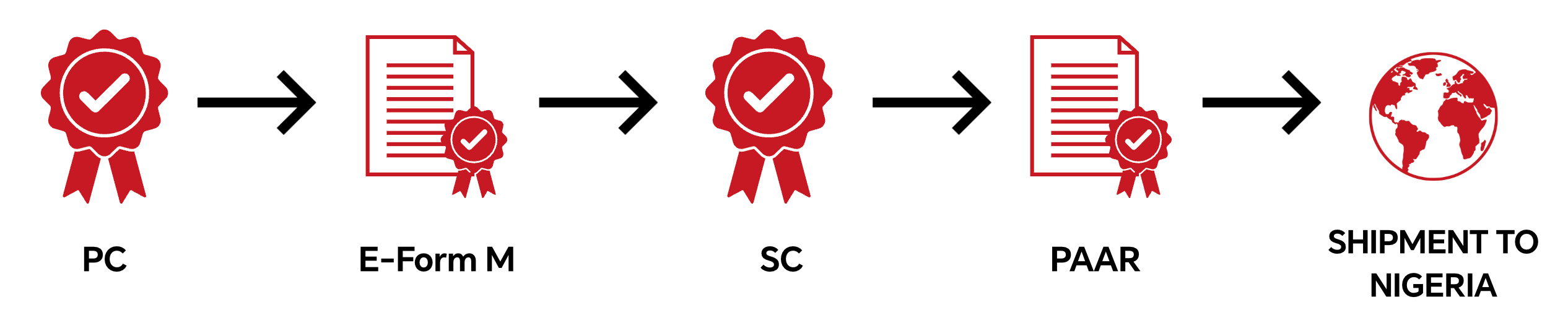
Steps for obtainingin SONCAP Compliance:
- Product Certificate (PC): Obtained during the initial export planning stage; it is the prerequisite for opening an e-Form M.
- E-Form M: Once the PC is issued, the importer uses the trade portal to validate it and populate the e-Form M. The completed application is then electronically transmitted to NICIS
- Shipment (SONCAP) Certificate (SC): Issued on a per-shipment basis following successful inspection. To apply for the SC, importers must provide their Tax Identification (TIN) Number along with the PC, final/commercial invoice and approved e-form M
- PAAR (Pre-Arrival Assessment Report): Upon receiving the SONCAP Certificate (SC), the importer activates it via the trade portal to initiate the PAAR application. By providing the necessary details and submitting them to the Nigeria Integrated Customs Information System (NICIS), an electronic PAAR is generated—provided all submitted data is valid.
Key requirements to obtain SONCAP Certification
To clear Nigeria Customs Service (NCS), every regulated shipment requires two distinct levels of certification. HQTS manages both:
1. Product Certificate (PC)
The prerequisite for opening an e-Form M. Exporters must choose a route based on shipment frequency and quality management systems (QMS):
PCU (Unregistered): For one-off or infrequent shipments.
PCR (Registered): For regular exporters with a verified Quality Management System.
PCL (Licensed): For high-volume manufacturers requiring long-term market access.
2. Shipment Certificate (SC / CoC)

The mandatory document for every individual consignment. Issued on a per-shipment basis following successful inspection. To apply for the SC, importers must provide their Tax Identification (TIN) Number along with the PC, final/commercial invoice and approved e-form M
Issued after successful physical inspection and testing.
Required to trigger the Pre-Arrival Assessment Report (PAAR) for final customs clearance.
Product Scope & Exemptions
While most manufactured goods require a CoC, certain categories are regulated or strictly exempt.
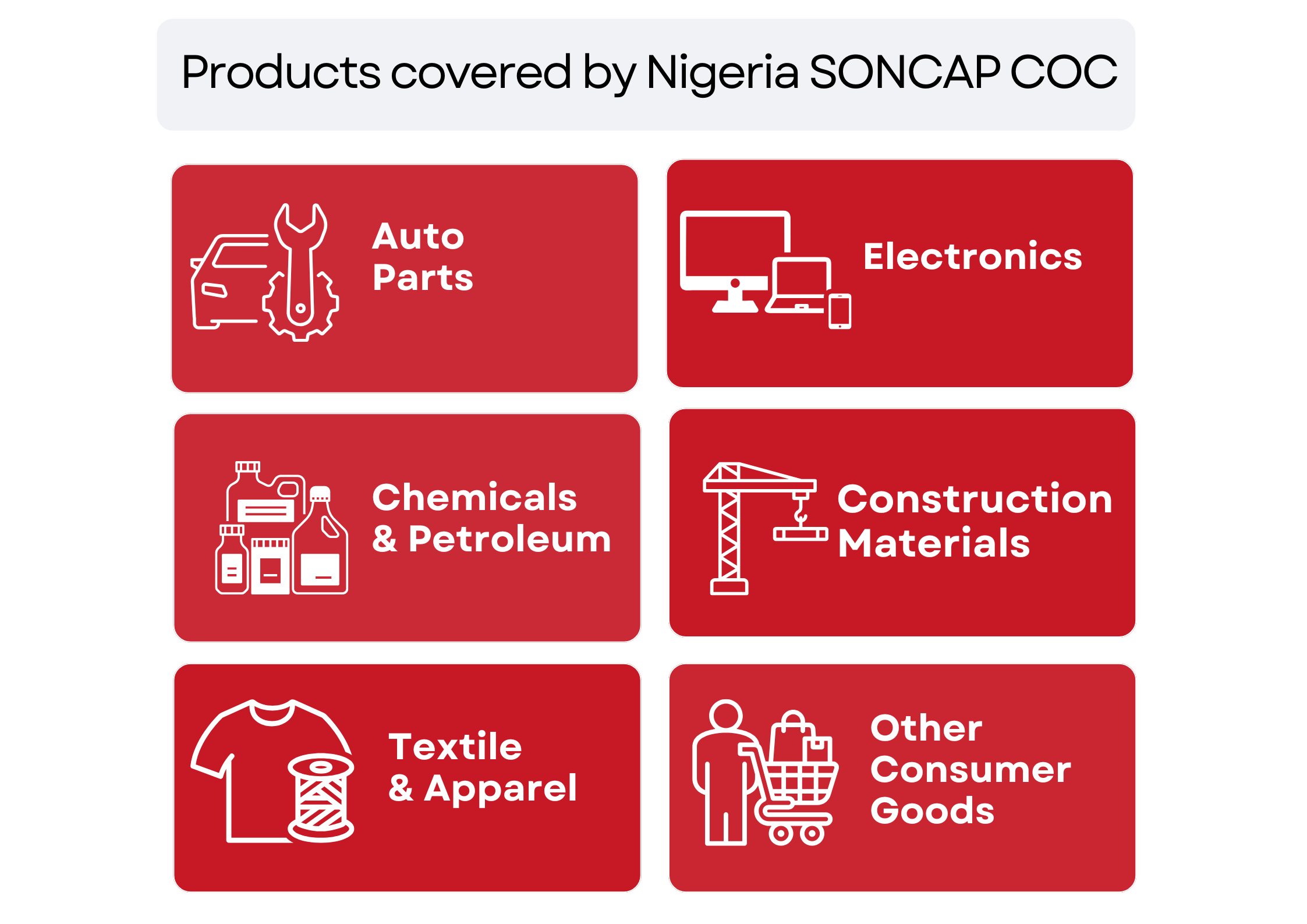
Mandatory Regulated Sectors Include:
- Automotive: Vehicles, motorcycles, and all spare parts.
- Electrical & Electronics: Including all electrical fittings.
- Chemicals & Petroleum: Petroleum appliances and CNG accessories for gas/kerosene stoves.
- Consumer Goods: Toys, childcare products, textiles, leather, footwear, and furniture.
New Requirement: As of 2025, all certifications must use the mandatory 10-digit H.S. Code from the Nigeria Customs Tariff.
Official Exempted Products:
- Food products and drugs (medicines).
- Medical supplies (excluding equipment and machines).
- Chemicals used as raw materials by bona fide manufacturers.
- Military wares and equipment.
- Used products (excluding automobiles).
The HQTS CoC Inspection Advantage
As a global leader in quality control, we don’t just “check boxes”—we protect your supply chain.
Global Network: Rapid inspection capabilities across China, India, and the Middle East.
Accredited Testing: Analysis performed in ISO/IEC 17025 certified laboratories.
Loading Supervision: We witness the stuffing and sealing of Full Container Loads (FCL) to ensure cargo integrity.
Digital Activation: We manage the mandatory activation of certificates on the Federal Government of Nigeria Single Window portal.