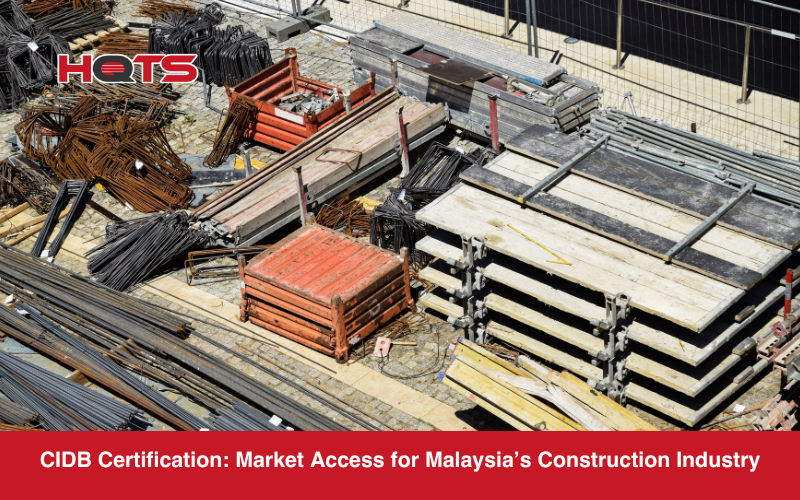
Entering Malaysia’s construction market requires more than competitive pricing and quality products. Without CIDB certification, building materials cannot be legally supplied to many construction projects, particularly government and large-scale developments.
For manufacturers and exporters, CIDB approval is not just a compliance formality. It is a prerequisite for market access, project acceptance, and long-term commercial growth in Malaysia.
This guide explains what CIDB certification is, which products are regulated, and how the application process works — with a focus on building material suppliers.
What Is CIDB Certification?
CIDB certification is issued by the Construction Industry Development Board (CIDB) Malaysia under Act 520. It regulates contractors, construction personnel, and selected construction materials used in Malaysia.
For product manufacturers, CIDB certification confirms that materials comply with applicable Malaysian Standards (MS). Certified products are approved for use in construction projects and may be required for government tenders or major private developments.
Without CIDB approval:
-
Materials may be rejected at site inspection
-
Products may be excluded from government-funded projects
-
Import clearance or project approval may be delayed
-
Distributors and contractors may refuse procurement
For overseas manufacturers, securing CIDB product certification is often the key step before appointing Malaysian distributors.
Scope of CIDB Product Certification
CIDB regulates more than 30 categories of construction materials. Products must comply with specific Malaysian Standards (MS) before they can be certified.
Common regulated categories include:
Ceramic Products
Tiles (MS ISO 13006)
Ceramic pipes and pipe systems (MS 1061)
Sanitary and Cleaning Equipment
Ceramic and plastic sanitary fittings (MS 147, MS 1522, MS 795)
Fiber Cement and Fiberboard (Non-Asbestos)
Roofing sheets, partition boards, ceiling boards (MS 1296)
Cement and Concrete Products
Portland cement and blended cement (MS EN 197, MS 898)
Precast concrete components (CIS 24)
Insulation Materials
Glass wool, rock wool, slag wool (MS 1020)
Radiation-proof insulation sheets (MS 2095)
Glass Products
Clear and tinted float glass (MS 1135)
Coated glass (MS 2397)
Tempered and laminated glass (MS 1498)
Wired glass (MS 2627)
Aluminum Products
Aluminum profiles (MS 2040)
Aluminum composite panels
Aluminum sheets and foil (MS 1848)
Steel Products
Hot-rolled and galvanized steel
Alloy steel plates
Steel wire and cables
Seamless and welded steel pipes
Welded stainless steel pipes
Each product category requires compliance testing according to its corresponding Malaysian Standard.
Core Process for CIDB Building Material Certification
For manufacturers and exporters, the CIDB certification process typically includes the following steps:
-
Application submission through the CIDB system
-
Preparation of complete product technical documentation
-
Laboratory testing at CIDB-accredited laboratories
-
Submission of test reports and supporting documents
-
Factory audit (if required)
-
Approval and issuance of certification
-
Affixing CIDB certification label to approved products
Test reports are generally valid for two years. Certification must be renewed before expiry to maintain market access.
Some products require dual certification, meaning both CIDB approval and SIRIM certification are mandatory.
Contractor Registration and Personnel Certification (Overview)
Although HQTS primarily supports product certification, clients often require clarity on related CIDB frameworks.
CIDB contractor registration is divided into Grade G1 to G7, depending on financial capacity and project size. G7 contractors have unlimited tendering capacity.
CIDB also requires construction workers to hold a Green Card, and foreign skilled workers must pass competency assessments. These elements are separate from product certification but may affect project approval and procurement decisions.
Required Documentation for CIDB Product Certification
A complete submission significantly reduces approval time. The typical documentation package includes:
-
Product Certification Questionnaire (ePCS/FOR/01-1)
-
Product Certification Application Form (ePCS/FOR/01-2)
-
Authorization Letter (ePCS/FOR/01-3)
-
Trademark Declaration (ePCS/FOR/01-4)
-
Manufacturer’s Declaration Letter (ePCS/FOR/01-5)
-
Full product specifications, including drawings, materials, components, product photos, surface finishes, performance data, labeling details, and installation instructions
-
Relevant laboratory test reports
-
Proof of application fee payment
Incomplete documentation or non-compliant test reports are the most common causes of rejection or delay.
Key Challenges for Overseas Manufacturers
Manufacturers outside Malaysia often face practical difficulties, including:
-
Identifying the correct Malaysian Standard (MS)
-
Coordinating testing with CIDB-accredited laboratories
-
Understanding whether SIRIM certification is also required
-
Managing factory audits and local representation
-
Ensuring labeling and packaging meet local requirements
A structured certification strategy helps reduce time to approval and avoid repeated testing costs.
Processing Time
The approval timeline depends on product category and testing complexity. In general:
-
Laboratory testing may take several weeks
-
Document review and approval may take one to two months
-
Additional time is required if factory audits or corrective actions are needed
Early preparation of technical documentation significantly shortens the overall timeline.
Conclusion
CIDB certification is a mandatory gateway for supplying regulated construction materials in Malaysia. For manufacturers, it directly impacts project eligibility, distributor partnerships, and access to government-funded developments.
With proper preparation of test reports, technical documentation, and compliance strategy, the application process can be managed efficiently and without unnecessary delays.
For companies planning to enter or expand in Malaysia’s construction market, obtaining CIDB product certification should be treated as a strategic market access requirement rather than a post-sales formality.