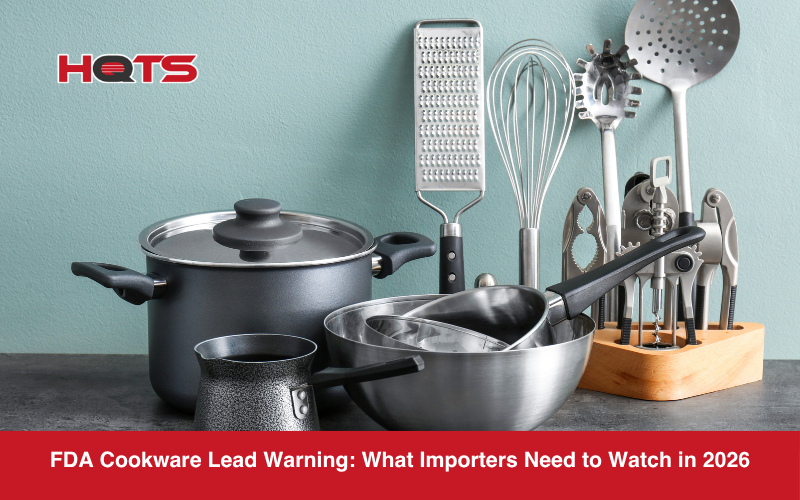
The U.S. Food and Drug Administration (FDA) has increased its scrutiny of heavy metals in kitchenware, with a particular focus on imported products. For U.S. cookware importers, compliance requirements have tightened following the August 2025 FDA cookware lead warning, which has since led to closer monitoring of aluminum and brass items.
As of March 2026, the range of products flagged for potential lead leaching has expanded. This has practical implications for importers, particularly the risk of shipment holds, recalls, or additional testing requirements at the border. This article outlines what has changed, where the risks typically arise, and what importers should verify before products enter the U.S. market.
The August 2025 FDA Cookware Lead Warning: A Turning Point for Importers
In August 2025, the FDA issued a series of safety communications highlighting certain imported cookware products found to leach measurable levels of lead (Pb) into food during use. Initial findings focused on a limited number of items. Since then, the scope has widened to include more than 19 product lines, with many originating from India and Pakistan.
One notable shift is where the FDA has been focusing its attention. Materials that historically received less scrutiny, such as uncoated aluminum, brass, and certain traditionally named alloys, are now being examined more closely.
The “Red Flag” Materials: Hindalium and Indalium
If your inventory includes cookware made from Hindalium (Hindolium) or Indalium (Indolium), it’s worth reviewing these products more closely. These aluminum-based alloys are commonly used in South Asian cookware, including items such as kadais, degdas, and topes. Under certain conditions, particularly when exposed to heat and acidic foods, testing has shown that some products made from these materials can release lead at levels above recommended limits.
This doesn’t mean all such cookware will fail compliance, but it does place these materials in a higher-risk category where verification through testing becomes important.
FDA Lead Cookware List: What is Being Targeted?
The FDA does not maintain a static “safe list.” Instead, it publishes a rolling FDA lead cookware list of products that have failed laboratory migration tests. Recent additions to the warning list include:
- Aluminum Kadais/Karahi: Wide, thick-walled cooking pans.
- Brass Topes and Pots: Often used for boiling or slow-cooking.
- Dolphin Brand & Silver Horse Products: Specific brands that have faced recent “FDA lead recalls.”
- Traditional Milk Pans: Small aluminum or alloy pitchers used for heating liquids.
What cookware contains lead?
While high-end stainless steel and certified ceramic are generally safe, lead is often found in the “filler” metals of low-cost aluminum alloys or in the glazes of poorly manufactured artisanal pottery. For importers, the danger lies in the impurity of the raw material used by overseas manufacturers.
The Science of Danger: Lead Poisoning from Cookware
The primary concern for the FDA is a lead in food warning. Unlike lead in paint, which requires ingestion of chips, lead in cookware migrates directly into the diet during the cooking process.
Why Lead in Aluminum Cookware is Unique
Lead is often added to aluminum alloys to improve “machinability” or is present as a contaminant in recycled scrap metal used by unregulated foundries. When acidic foods (like tomatoes or vinegar) are cooked in these vessels, the chemical reaction accelerates the leaching process.
Health Impact: The FDA emphasizes that there is no known safe level of exposure to lead. Even low-level chronic exposure can lead to:
- In Children: Lowered IQ, behavioral changes, and developmental delays.
- In Adults: Hypertension, kidney damage, and reproductive issues.
- Symptoms: Fatigue, persistent headaches, and abdominal pain.
Regulatory Framework: The Importer’s Legal Burden
Under the Federal Food, Drug, and Cosmetic Act (FFDCA), it is the legal responsibility of the U.S. importer, not the overseas manufacturer, to ensure that food contact materials (FCM) are safe.
FDA Lead Recalls and Enforcement
If a product is found to be “adulterated” (containing a substance that may render it injurious to health), the FDA can:
- Issue an Import Alert: Automatically detaining all future shipments from that manufacturer.
- Mandate a Class I Recall: The most serious type of recall, requiring the public removal of products already in consumer homes.
- Civil Penalties: Fines and legal action against the distributing company.
The FDA Testing Protocol
To verify compliance, the FDA utilizes a specific lead leach testing protocol. Unlike standard “surface” tests, this involves:
- A two-hour boil in a 4% acetic acid solution.
- A 24-hour hold at room temperature.
- Analysis of the solution to measure exactly how many micrograms of lead migrated from the metal.
If your current testing regimen does not mirror these specific FDA lead recall parameters, your products are at risk of detention at the port of entry.
Compliance Guide: What to Buy and Import
To protect your brand reputation and bottom line, importers should shift their sourcing strategy toward materials with a lower risk profile and verified testing data.
| Material | Risk Level | Compliance Requirement |
| Virgin Aluminum | Medium | Requires 21 CFR 175.300 testing to ensure purity. |
| Hindalium/Indalium | High | Strictly avoid without batch-specific lead migration reports. |
| Stainless Steel (304/316) | Low | Verify “Heavy Metal” migration limits. |
| Cast Iron | Low | Check for lead-free certifications in the seasoning/coating. |
| Ceramic/Glazed | Medium | Requires rigorous leaching tests for lead and cadmium. |
How HQTS Protects Your Cookware Imports
Navigating the FDA cookware lead warning goes beyond relying on supplier documentation. As enforcement continues to tighten in 2026, many importers are finding that paperwork alone is not always enough to satisfy regulatory scrutiny at the border or in the market.
In recent months, we’ve seen an increase in detentions linked to products backed only by supplier-issued certificates. In many cases, the issue is not the absence of documentation, but a gap between what was certified and what was actually produced. To reduce that risk, a more structured approach to verification is usually needed.
1. Shift Away from High-Risk Alloys
If your manufacturer uses “recycled aluminum scrap,” the risk of lead contamination is nearly 100%. Demand Virgin Aluminum and verify the metallurgical composition before production starts.
2. Implement Batch-Specific Testing
Don’t rely on a test report from three years ago. The FDA’s 2026 enforcement strategy is based on routine sampling at retail and border points. HQTS Food Contact Materials Testing offers:
- Heavy Metal Migration Analysis: Conducted in our ISO-accredited labs using the exact 24-hour FDA leach protocol.
- Purity Verification: Identifying traces of lead in alloys like Hindalium before they ship.
3. Factory Audits & Raw Material Sourcing
Our on-site auditors in India, Pakistan, and China can verify that your factory isn’t mixing “filler metals” into the melt. We check the “ingot-to-finished-good” pipeline to ensure transparency.
HQTS offers specialized Food Contact Materials (FCM) Testing Services designed specifically for U.S. importers. We help you bridge the gap between overseas manufacturing and FDA compliance through:
- Heavy Metal Migration Testing: We utilize the exact FDA-approved protocols (including the 24-hour leach test) to ensure your aluminum and brass products are lead-free.
- Factory Audits: We inspect the raw material sources of your manufacturers to ensure they aren’t using contaminated scrap metal or unsafe alloys like Hindalium.
- Global Laboratory Network: With accredited labs across Asia and a dedicated team in the U.S., we provide fast turnaround times to keep your supply chain moving.
- Regulatory Consulting: Not sure if your new product line falls under the latest FDA alert? Our experts provide up-to-the-minute guidance on 21 CFR requirements.
Don’t wait for an FDA detention notice to find out your products are non-compliant. Protect your customers and your business by ensuring every piece of cookware you import meets the highest safety standards.