In global manufacturing, the first units off the line tend to reveal how the rest of the order will go. If the initial 5% is produced incorrectly, there’s a strong chance the same issues will repeat across the remaining 95%. An Initial Product Inspection (IPI), sometimes referred to as a Pre-Production Inspection or IPC, gives you the first real checkpoint to confirm that your specifications have been correctly translated into the product.
For importers, this functions as an early signal rather than a final judgment. By reviewing output at the very start of production, you can catch misunderstandings, material substitutions, or process inconsistencies before they scale into a larger issue.
What is an Initial Production Inspection (IPI)?
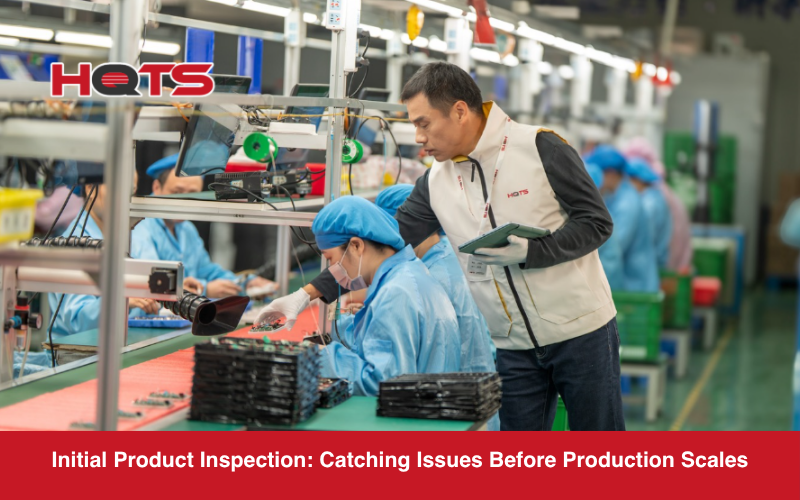
An Initial Product Inspection is a quality control step carried out at the very start of production—typically when around 0% to 20% of the goods have been completed. Unlike a final inspection, which takes place once production is finished, an IPI focuses on what’s happening early on: the raw materials being used, how the production line is set up, and the first finished units coming off the line.
At HQTS, we recommend an IPI especially when:
- You are working with a new supplier for the first time.
- Your product has a complex design or high-precision requirements.
- You are using expensive raw materials that cannot be easily replaced.
- You have a strict deadline and cannot afford a total production restart.
The Benefits of Starting with an IPI
Carrying out an inspection at the start of production offers advantages that are difficult, if not impossible, to recover at the final stage:
- Early Problem Detection: Identify issues with color, dimensions, or workmanship when only a small fraction of the order is affected.
- Cost Prevention: It is far cheaper to stop a line and adjust a machine setting than it is to rework 10,000 finished units.
- Supplier Accountability: An IPI signals to the factory that you are a diligent buyer who prioritizes quality, discouraging “corner-cutting” early on.
- Schedule Assurance: By catching errors on Day 1, you avoid the massive shipping delays that occur when a final batch is rejected just days before the vessel departs.
What are the Steps for an Initial Production Inspection?
A well-executed IPI follows a defined process to review the key variables in production. At HQTS, this typically involves seven core steps:
1. Raw Material & Accessory Check
The inspector verifies that the factory is using the specific materials you paid for. This includes checking the grade of steel, the type of plastic resin, or the quality of fabric. We ensure that no unapproved “filler” materials or substandard components have been substituted.
2. Prototype Comparison
The first finished units are compared directly against your “Golden Sample” or approved prototype. We verify that the aesthetic, feel, and weight match your expectations exactly.
3. Production Line Audit
We don’t just look at the product; we look at the process. Our inspectors evaluate the machinery, the number of workers assigned to your line, and the factory’s internal quality control points.
4. Workmanship & Visual Inspection
Using a random sampling method, the inspector checks for common defects:
- Aesthetics: Scratches, dents, or uneven paint/finishes.
- Assembly: Loose screws, poor welding, or incorrect alignment.
- Branding: Correct placement of logos, labels, and hangtags.
5. On-Site Testing (The “Stress Test”)
Even at the initial stage, we perform basic functional tests. For example, if you are manufacturing electronics, we will power on the first units to ensure they function. For garments, we may perform pull-tests on buttons or check seam strength.
6. Packaging & Labeling Review
We verify that the inner and outer packaging meets your specifications. Incorrect barcodes or shipping marks are a leading cause of warehouse rejection in the U.S. and Europe, catching these early saves thousands in relabeling costs.
7. The Detailed IPI Report
Within 24 hours of the inspection, HQTS provides a comprehensive report complete with high-resolution photos, a pass/fail result, and technical recommendations for the factory to improve quality as they scale up to full mass production.
IPI vs. DPI: What’s the Difference?
Importers often face the question of whether to use an Initial Product Inspection (IPI) or move straight to a During Production Inspection (DPI).
| Feature | Initial Production Inspection (IPI) | During Production Inspection (DPI) |
| Timing | 0% – 20% complete | 20% – 80% complete |
| Focus | Raw materials & initial setup | Consistency of mass production |
| Goal | Preventing “First Batch” errors | Monitoring the production schedule |
| Best For | New suppliers/New designs | Large orders with long lead times |
Secure Your Order from Day One with HQTS
A “wait and see” approach to quality control is becoming increasingly difficult to justify. In practice, shorter production cycles and tighter delivery timelines leave little room to correct issues late in the process. Early intervention is no longer optional, it’s part of managing risk. HQTS combines global experience with on-the-ground inspection to help ensure production starts as intended.
By carrying out an Initial Product Inspection, you gain a clear view of how the factory is operating at the outset—its materials, processes, and consistency with your requirements. Our inspectors work directly on-site, giving you visibility into whether production is aligned with your standards before volumes increase.
If you are preparing for a new production run, an early-stage inspection can help confirm that your supplier is ready, before issues scale.