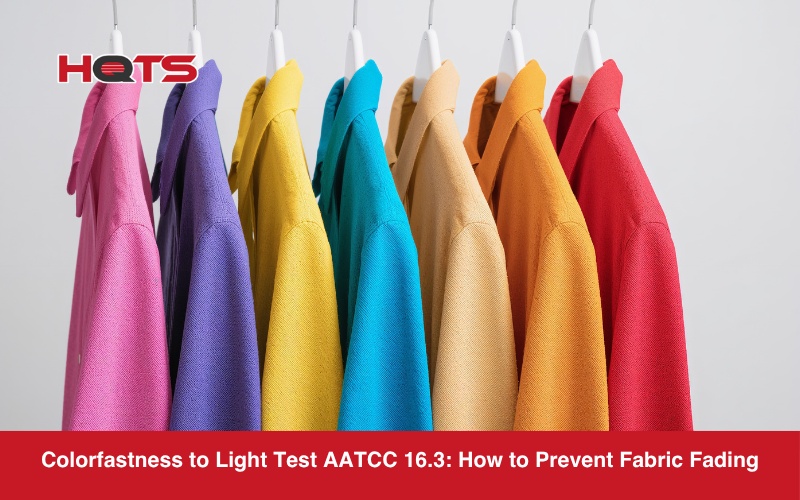
For textile manufacturers and U.S. importers, product durability isn’t only about fiber strength—it’s also about how well the color holds over time. Whether it’s outdoor awnings, upholstery, or everyday apparel, fading is one of the more common reasons products are rejected or returned.
In the North American market, the reference point for this is AATCC TM16.3—the standard for Colorfastness to Light (Xenon-Arc). With the 2026 AATCC Technical Manual (Volume 101), applying the method correctly depends not just on running the test, but on selecting the right conditions for the product’s actual use.
What is AATCC 16.3?
AATCC 16.3 is a test method developed by the American Association of Textile Chemists and Colorists to measure how resistant a textile’s color is to fading when exposed to light.
Unlike earlier methods based on carbon-arc lamps, this standard uses a Xenon-arc light source. When properly filtered, it provides a closer simulation of natural sunlight across the spectrum, including UV wavelengths that drive dye degradation. The distinction matters, particularly for products intended for outdoor or high-exposure environments.
The Core Process: How the Test is Conducted
The test is designed to simulate extended light exposure under controlled conditions, rather than simply exposing fabric to a light source.
1. Controlled Exposure
Specimens are placed in a Xenon-arc chamber (often a “Weather-Ometer”). The machine precisely regulates:
- Irradiance: The intensity of the light.
- Black Panel Temperature: The heat absorbed by the fabric surface.
- Relative Humidity: To simulate dry vs. humid climates, which can accelerate fading.
2. The Use of Blue Wool Standards
To ensure the test is accurate, “Blue Wool” reference scales are exposed alongside the textile samples. These are strips of wool dyed with specific light-sensitive dyes that fade at a known, calibrated rate. This allows the lab to verify that the Xenon-arc machine is delivering the correct amount of “Accelerated Fading Units” (AFU).
3. Evaluation via Gray Scale
Once the exposure is complete (typically at 20, 40, or 60 hours), the sample is compared to the original, unexposed fabric. The color change is rated on the AATCC Gray Scale for Color Change:
- Grade 5: No change (Excellent fastness).
- Grade 1: Severe change (Very poor fastness).
AATCC 16.3 Test Options: Which One Do You Need?
The standard provides different “options” or sets of conditions based on where the product will be used. Choosing the wrong one can lead to misleading results.
| Option | Exposure Type | Best For |
| Option 1 | Alternating Light/Dark | Indoor textiles that experience “day/night” cycles (Curtains, Drapes). |
| Option 2 | Continuous Light | Constant-exposure environments (Upholstery in sunrooms). |
| Option 3 | Continuous Light (Specific) | The Industry Standard for most apparel and general textiles. |
Why AATCC 16.3 Matters for 2026 Supply Chains
In the current 2026 regulatory and retail environment, quality claims are under intense scrutiny.
- Retailer Mandates: Major U.S. retailers (Amazon, Target, Walmart) often require a minimum Grade 4 at 40 hours for apparel and significantly higher for outdoor goods.
- Sustainability & Dyes: As the industry shifts toward eco-friendly and natural dyes, many of these alternatives are more sensitive to light. AATCC 16.3 testing is the only way to verify if “green” dyes meet performance expectations.
- Risk Mitigation: Discovering that a batch of fabric fades after 10 hours of sun exposure before it is sewn into 5,000 jackets saves hundreds of thousands of dollars in potential recalls and brand damage.
How HQTS Ensures Your Color Integrity
Navigating the technicalities of AATCC standards requires a laboratory partner that understands the nuances of the 2026 AATCC Manual. HQTS offers comprehensive Colorfastness Testing Services that go beyond just providing a number on a report. Working with AATCC standards often comes down to interpretation, especially when products are sold across different markets or environments. HQTS supports this process through a combination of lab testing and practical guidance.
Our Specialized Textile Lab Services:
- AATCC 16.3 (Option 1, 2, 3): Fully accredited Xenon-arc testing with precision climate control.
- Multi-Standard Testing: We can simultaneously test against ISO 105-B02 (the European counterpart) if you are targeting global markets.
- Dye & Chemical Analysis: If a fabric fails the light test, our chemical experts can help identify if the issue is the dye type, the finish, or the fiber composition.
- Fast Turnaround: With our global network of labs in major textile hubs (China, Vietnam, India), we provide the data you need to make “ship or no-ship” decisions quickly.
Protect your brand’s reputation by ensuring your colors stay as vibrant as the day they were produced.
Do you have a new fabric line that needs validation? Would you like a quote for AATCC 16.3 testing or a consultation on which test option is right for your product?