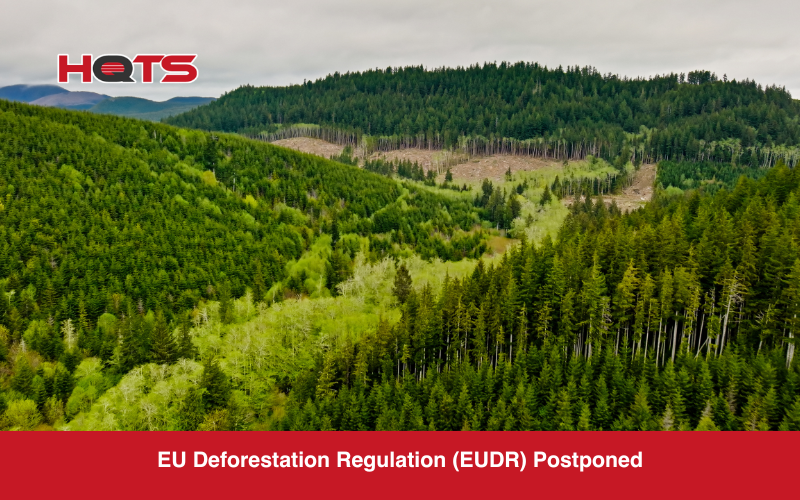
In a significant development for global supply chains, the European Union has approved a one-year delay to the enforcement of the EU Deforestation Regulation (EUDR). This move, backed by both the European Parliament and the Council, aims to address mounting concerns from businesses and authorities regarding readiness, administrative burdens, and technical challenges. The regulation, designed to curb deforestation-linked imports, will now apply from December 30, 2026, for large and medium operators, with small and micro enterprises gaining an additional grace period until June 30, 2027.
At HQTS, we’ve been at the forefront of helping companies navigate complex compliance landscapes like the EUDR. This delay provides a much-needed breathing room, but it doesn’t mean hitting pause on preparations. In this post, we’ll break down the new timeline, highlight the proposed simplifications, and share actionable steps to stay ahead.
What is the EUDR and Why the Delay?
The EUDR, formally known as Regulation (EU) 2023/1115, mandates that operators and traders ensure products placed on or exported from the EU market—such as coffee, cocoa, soy, palm oil, rubber, wood, and related derivatives—are deforestation-free. This means proving that these goods were produced on land not deforested after December 31, 2020, through rigorous due diligence statements (DDS) and traceability via geolocation data.
Originally slated for December 30, 2025 (after an initial delay from 2024), the regulation faced pushback due to:
- IT System Delays: The EU’s centralized information system for DDS submissions isn’t fully operational.
- Administrative Overload: Small businesses and downstream operators (e.g., retailers) struggled with multi-layered reporting requirements.
- Supply Chain Disruptions: Early compliance could have led to economic fallout in key exporting countries, prompting calls for simplification from member states like Germany and Austria.
On November 26, 2025, the European Parliament voted 402-250 to endorse the Council’s proposal, paving the way for trilogue negotiations. While formal adoption is pending (expected before year-end), the original deadlines technically stand until then—urging companies to continue preparations.
The New Timeline: Phased Rollout for Different Operator Sizes
The delay introduces a tiered approach to ease the transition:
| Operator Type | Original Deadline | New Deadline | Key Notes |
|---|---|---|---|
| Large & Medium | Dec 30, 2025 | Dec 30, 2026 | Full due diligence and DDS requirements apply. Products placed on the market before this date are exempt as “old stock.” |
| Small & Micro | Jun 30, 2026 | Jun 30, 2027 | Extended grace period; even simpler obligations (see below). Products from these operators remain exempt when used by larger firms until the deadline. |
This staggered timeline recognizes the varying capacities of businesses, with the European Timber Regulation (EUTR) bridging the gap by remaining in effect until the EUDR kicks in.
Key Simplifications: Reducing the Compliance Burden
Beyond the delay, the approved changes include targeted measures to streamline implementation, particularly for smaller players and downstream supply chains. These build on the European Commission’s October 2025 proposal but go further:
- Single DDS Submission: Only the first operator placing EUDR-relevant products on the EU market must submit a full DDS to the IT system. Downstream operators (e.g., manufacturers or retailers) no longer need to file separate statements but must retain due diligence records for audits.
- Relief for Small & Micro Operators: These businesses can use simplified traceability, such as postal codes instead of precise geolocation coordinates, and submit just one streamlined declaration. For primary operators in low-risk countries (per EU benchmarking), a single DDS suffices.
- Mandatory Review by April 30, 2026: The Commission will assess the regulation’s administrative impact—focusing on micro/small operators—and propose further tweaks. This pre-enforcement review could lead to even lighter obligations.
- Exemptions Under Discussion: The Parliament proposes fully excluding printed materials (e.g., books, newspapers under HS Chapter 49), though this awaits final Council approval.
- Grace Periods and Legacy Stock: No enforcement actions for six months post-deadline in some cases, and pre-2026 inventory is grandfathered in.
These adjustments aim to cut red tape while preserving the EUDR’s core goal: ensuring 100% deforestation-free supply chains.
Implications for Global Supply Chains
For importers, exporters, and manufacturers worldwide, this reprieve is a double-edged sword. On one hand, it mitigates short-term risks like supply shortages or cost spikes—vital for sectors like agriculture and timber. On the other, it underscores the need for proactive planning, as non-EU countries (e.g., Indonesia, Brazil) are already aligning policies.
Critics, including EU Executive Vice-President Teresa Ribera, argue the delay weakens environmental momentum, but proponents highlight that rushed implementation could backfire economically. At HQTS, we see this as an opportunity to build resilient, transparent supply chains that exceed EUDR standards.
What Should Companies Do Next?
Don’t let the delay lull you into complacency—the EUDR’s requirements are here to stay, and early movers will gain a competitive edge. Here’s our roadmap:
- Map Your Supply Chain: Identify EUDR-relevant products and hotspots for deforestation risk. Tools like GIS mapping and supplier audits are essential.
- Conduct Risk Assessments: Use the EU’s upcoming country benchmarking to classify suppliers as low/medium/high risk and tailor due diligence accordingly.
- Invest in Traceability Tech: Prepare for geolocation data collection; blockchain or ERP integrations can automate this.
- Train Your Team: HQTS offers tailored EUDR workshops, from executive briefings to hands-on compliance training.
- Partner with Experts: Engage third-party verifiers early to validate DDS and avoid penalties (up to 4% of EU turnover).
HQTS has supported hundreds of clients through regulations like the EUTR and emerging ESG mandates. Our global network of auditors ensures on-the-ground insights, from farm-level traceability in Southeast Asia to factory audits in Europe.
Final Thoughts
The EUDR delay to 2026/2027 is a pragmatic pivot, balancing sustainability ambitions with business realities. By simplifying processes and extending timelines, the EU is fostering a more inclusive path to deforestation-free trade. Yet, the message is clear: preparation is non-negotiable.
Ready to deforestation-proof your supply chain? Contact the HQTS team today for a free compliance consultation. Let’s turn this regulatory shift into a strategic advantage.