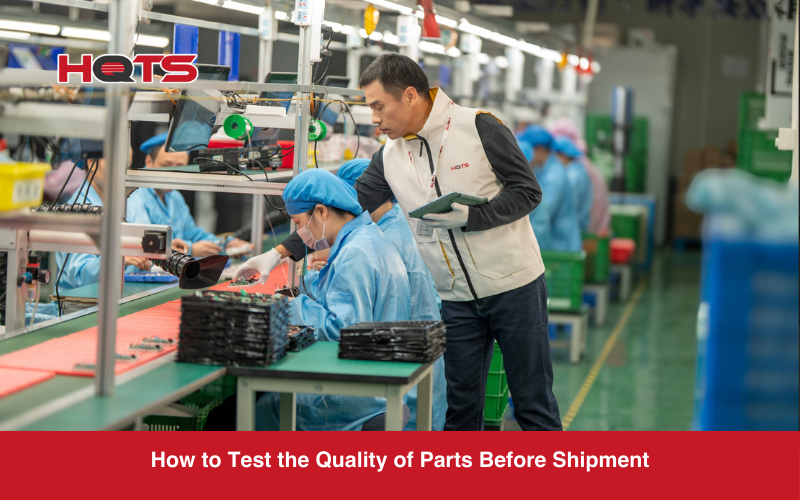
For global importers the priciest error is finding a flaw after the container’s been paid for and dispatched. To avoid this costly scenario, importers need to go beyond basic checklists. They must establish a robust system to test the quality of parts before shipment.
As a global leader in quality assurance, HQTS emphasizes that a Pre-Shipment Inspection (PSI) is not just a formality; it is the final gatekeeper that protects your brand, your budget, and your customers. This guide outlines the professional methodologies and technical steps used to verify part quality at the factory floor.
Types of Inspections done just before the shipment
Depending on your product type and risk tolerance, different inspection models may be required.
1. Final Random Inspection (FRI) or Pre-shipment Inspection (PSI)
This is the most common method. An inspector selects a statistically significant sample from the total batch (usually based on the AQL standard) to check for defects. If the number of defects exceeds the limit, the entire batch is rejected.
2. Piece-by-Piece (100% Sorting) Inspection
For high-value parts or critical automotive components, a random sample may not be enough. In a Piece-by-Piece inspection, every single item is checked. At HQTS, we often perform this for luxury goods or high-precision industrial parts where a 0% defect rate is mandatory.
3. Consignment-Wise Inspection
Specifically used for government-mandated exports (such as shipments to Saudi Arabia or Uzbekistan), this ensures the consignment meets the specific regulatory standards of the destination country.
What is a Pre-Shipment Inspection (PSI)?
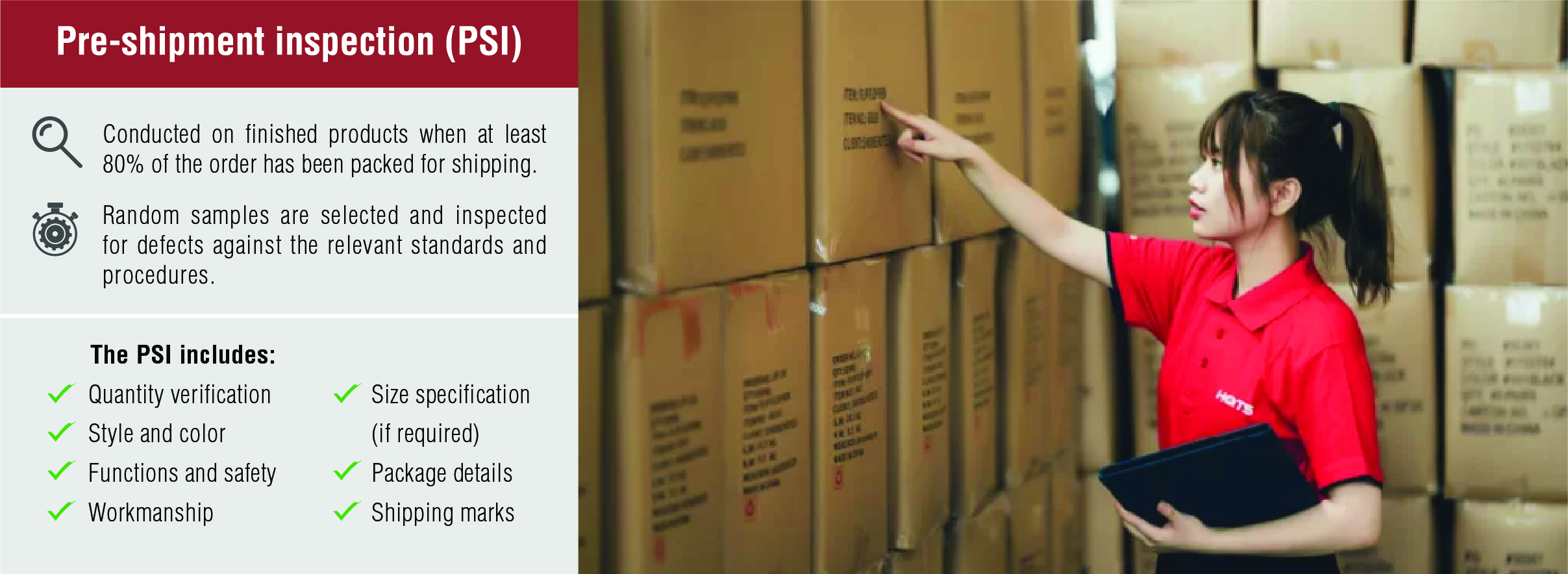
A Pre-Shipment Inspection is a systematic on-site evaluation of randomly selected units from all batches of your order. It is typically conducted when production is 100% finished and at least 80% of the goods are packed.
The goal of a PSI is to verify that the manufactured parts fully comply with your specifications, purchase orders, and international safety standards before they are dispatched. At HQTS, we treat the PSI as your last chance to identify non-conformities while the goods are still in the manufacturer’s hands and can be reworked or replaced.
How to Test the Quality of Parts Before Shipment
Professional testing requires a blend of statistical sampling, physical measurements, and functional stress tests. Here is the process we follow to ensure your parts are “market-ready.”
1. Statistical Sampling via AQL (ISO 2859-1)
Testing every single part is often cost-prohibitive. Instead, we use the Acceptable Quality Limit (AQL) standard. This allows us to select a statistically significant sample size that accurately represents the quality of the entire lot.
- Critical Defects: Zero tolerance. These are issues that make the part hazardous.
- Major Defects: Issues that affect the part’s functionality or salability.
- Minor Defects: Cosmetic imperfections that do not affect the part’s use.
2. Dimensional and Conformity Verification
The first step in physical testing is ensuring the parts match your technical drawings. We verify:
- Physical Attributes: Length, width, weight, and thickness using calibrated calipers and micrometers.
- Color & Finish: Comparing the parts against a “Golden Sample” or Pantone swatches to ensure consistency across the batch.
- Marking & Labeling: Verifying that serial numbers, barcodes, and country-of-origin markings (e.g., “Made in Vietnam”) are accurate and legible.
3. Functional and Mechanical Testing
A part that looks correct but fails to operate is a liability. Depending on the industry (Automotive, Industrial, or Electronics), we perform specific “field tests”:
- Operational Checks: Ensuring moving parts rotate, click, or lock as intended.
- Hi-Pot & Earth Grounding: For electrical parts, ensuring there is no risk of short circuits or shocks.
- Durability Tests: Stress-testing the material to ensure it doesn’t fracture under specified loads.
4. Packaging and “Carton Drop” Tests
Quality testing extends to how the parts are protected. We conduct a Carton Drop Test (ISTA standards) to ensure that the packaging is robust enough to survive the vibration and impact of international transit. If the packaging fails, the quality of the parts inside is irrelevant.
Other Types of Quality Inspection
While the PSI is the most common, a comprehensive quality strategy often involves testing at multiple stages:
| Inspection Type | When it Happens | Primary Goal |
| Pre-Production (PPI) | Before mass production | Test raw materials and components for purity and spec-matching. |
| During Production (DPI) | 20% – 50% completion | Identify “bottleneck” defects early to avoid bulk failures. |
| Pre-Shipment (PSI) | 80% – 100% packed | Final verification of quality, quantity, and packaging. |
| Piece-by-Piece (100%) | Post-production | Checking every single unit—ideal for high-precision or luxury parts. |
| Loading Supervision | At the container | Ensure the correct (inspected) goods are loaded safely. |
Why Professional Third-Party Test of Parts before shipment is Crucial in 2026
In today’s volatile market, relying on a supplier’s self-report is a high-risk strategy. HQTS provides an objective, non-discriminatory lens through which to view your supply chain.
The Benefits of HQTS Inspection Services:
- On-Site Within 72 Hours: Our global network allows us to be in the factory quickly, preventing shipment delays.
- Accredited Expertise: Our labs and inspectors are ISO-certified, ensuring your inspection reports are legally defensible for letters of credit or insurance claims.
- Transparency: Every inspection concludes with a detailed report featuring high-resolution photos and video evidence of all tests performed.
- Risk Mitigation: By catching defects at the source, you eliminate the costs of returns, customs detentions, and the “hidden costs” of customer dissatisfaction.
Secure Your Supply Chain at the Source
To test the quality of parts before shipment is to invest in the longevity of your business. Whether you are importing precision automotive components or consumer electronics, a rigorous Pre-Shipment Inspection ensures that your standards are upheld, regardless of where the factory is located.
At HQTS, we specialize in transforming the “unknowns” of manufacturing into data-backed certainty. Don’t pay for defective goods—verify your quality at the source.