If you want to sell low-voltage electrical equipment or children’s toys within the Gulf region, your products must carry the Gulf Conformity Mark (G-Mark). Navigating international regulatory compliance can be a significant hurdle, but securing this mark is an absolute requirement for entering these highly lucrative Middle Eastern markets.
Following recent strategic corporate acquisitions and an expanded physical footprint within the United Arab Emirates (UAE), HQTS has fully relaunched its comprehensive G-Mark testing and certification services to provide global manufacturers with an accelerated route to Middle Eastern market entry.
What is G-Mark Certification?
The G-Mark (Gulf Conformity Mark) is a mandatory compliance and safety marking required for low-voltage electrical equipment (LVE) and children’s toys imported into or sold within the Gulf Cooperation Council (GCC) member states. Managed by the GCC Standardization Organization (GSO), it signifies that a product complies with all applicable regional Gulf Technical Regulations regarding health, safety, and environmental protection.
Established to harmonize trading standards across the Middle East, the G-Mark functions similarly to Europe’s CE marking. It represents a unified regulatory passport—once a product is successfully certified in one member state, it can freely move across all participating borders without undergoing duplicate testing.
Rather than a symbol of premium quality or a marketing gimmick, the G-Mark denotes strict fulfillment of essential baseline safety and environmental thresholds. Under the official framework, the legal responsibility for maintaining compliance rests entirely on the manufacturer, their authorized regional representative, or the importer introducing the product into the Gulf market.
Which Countries are Covered by G-MARK?
The G-Mark is legally mandatory in all seven member states of the Gulf economic zone, which includes the United Arab Emirates (UAE), Saudi Arabia (KSA), Bahrain, Qatar, Kuwait, Oman, and Yemen. Any regulated product entering these territories without an active certificate will be blocked at the border by local customs authorities.
While the core technical framework is managed collectively at the regional level by the GSO, the standard is strictly enforced at individual national customs borders by each country’s respective regulatory body, such as SASO in Saudi Arabia or MoIAT in the UAE.
The full geographical scope covers:
- United Arab Emirates (UAE)
- Kingdom of Bahrain
- Kingdom of Saudi Arabia (KSA)
- Sultanate of Oman
- State of Qatar
- State of Kuwait
- Republic of Yemen (Note: Yemen actively enforces and recognizes the G-Mark regulations despite its unique political status relative to the core GCC block).
Product Scope & Regulated Items
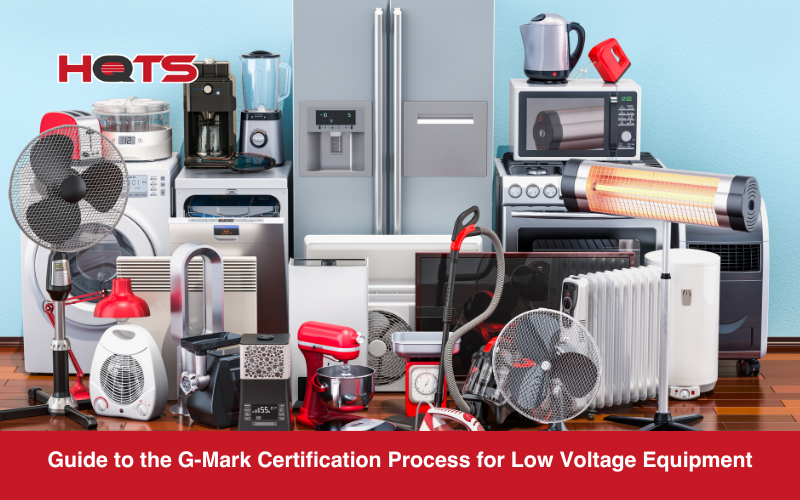
The G-Mark regulation applies strictly to two major product categories: Children’s Toys and Low-Voltage Electrical Equipment (LVE) designed for domestic, household use. Children’s toys include any product designed or intended for use in play by children under 14 years of age. Low-voltage electronics are classified into two lists based on consumer risk, with higher-risk items (List 2) requiring mandatory third-party intervention.
The technical regulations define low-voltage equipment as products operating within a nominal voltage rating of AC 50–1000 V or DC 75–1500 V.
- List 1 (Low Risk): Products subject to a self-declaration process by the manufacturer.
- List 2 (High Risk): Higher-risk household electrical items that must be independently certified by a GSO-approved Notified Body (NB).
The table below outlines the primary regulated household electrical goods under List 2 along with their associated Harmonized System (HS) codes:
| HS Code | Product Category |
| 84145100 / 84145900 | Domestic electrical fans |
| 84181000 – 84184000 | Refrigerators, freezers, and cooling equipment |
| 84211200 / 84501100 – 1900 | Centrifugal clothes dryers and washing units |
| 85094000 | Food grinders, mixers, and juice extractors |
| 85167200 | Toasters |
| 85163100 – 85163300 | Electro-thermic hair-dressing apparatus and hand dryers |
| 85162910 | Domestic electric space heating apparatus |
| 85165000 | Microwave ovens |
| 85166000 | Ovens, cookers, cooking plates, grillers, and roasters |
| 85161000 | Electric instantaneous/storage water heaters |
| 85164000 | Electric smoothing irons |
| 85444220 / 85366910 | Plugs, socket outlets, adaptors, and chargers |
| 84151000 | Air conditioners |
⚠️ Key Exemptions: Electrical equipment designed for use in explosive atmospheres (ATEX), specialized medical or radiological equipment, passenger lifts, electricity meters, and specialized components used on ships, aircraft, or railways are completely exempt from this specific scope.
Requirements & Steps to Obtain the G-Mark
To secure a G-Mark certificate, manufacturers must complete a structured compliance workflow that involves assembling a comprehensive technical file, passing safety and compatibility testing via an accredited laboratory, and obtaining validation from a GSO Notified Body. Once approved, the product is registered in the official GSO tracking system, and a 3-year certificate is issued.
The certification process follows a strict chronological sequence to ensure that both design and production capabilities meet regional safety thresholds:
1.Compile Technical Files & Documentation: Pre-evaluation.
Gather the application form, proof of organizational legal entity, comprehensive technical drawings, product descriptions, and factory ISO 9001 quality certificates.
2.Conduct Risk Assessment: Mandatory Safety Analysis.
The manufacturer must draft a detailed Risk Assessment Report mapping out potential electrical, mechanical, or environmental hazards and detailing how the design mitigates them.
3.Product Safety & EMC Testing: Accredited Lab Testing.
Submit product samples to a GSO-notified testing laboratory. The product must undergo evaluation against Gulf standards (or IEC equivalents with specific national deviations) for safety and Electromagnetic Compatibility (EMC).
4.Notified Body Evaluation: Review & Issuance.
Submit all test reports and technical files to an authorized Notified Body. Upon a successful verification check, the Notified Body registers the product and generates the unique G-Mark profile.
Required Application Checklist
Before initiating your application, ensure your compliance team has the following documentation fully compiled:
- Manufacturer and Importer Declaration of Conformity (DoC) drafted in both English and Arabic.
- Valid safety test reports issued within the last 3 years by an accredited laboratory.
- Detailed bill of materials (BOM) or bill of substances (BOS).
- High-resolution photos showing the trademark, country of origin, and rating labels.
The G-Mark Label & GCTS
The physical label attached to compliant products is known as the GSO Conformity Tracking Symbol (GCTS). This symbol is composed of two mandatory, un-severable elements: the official G-Mark logo and a unique, scannable QR code that allows customs authorities and consumers to instantly verify the active validity of the certificate in the public database.
The design rules for the GCTS are highly specific, and any deviation can result in cargo delays at the port of entry.
- Size Constraints: The G-Mark must maintain its official proportions and cannot be scaled down below a minimum height of 5 mm.
- The QR Code Component: Generated automatically by the GSO tracking database during final registration, the QR code links directly to the public registry page containing product identification data.
- Placement and Durability: The GCTS must be permanently affixed, clearly visible, and virtually impossible to erase. It must be printed directly on the product body. If the product’s physical size or nature prevents this, it must be prominently displayed on the primary packaging and accompanying instruction manuals.
Why the G-Mark is Important: Risks of Non-Compliance
Failing to secure a valid G-Mark means your products cannot legally cross customs checkpoints into any GCC country, leading to immediate border rejections, severe financial penalties, and mandatory product destruction. Border enforcement across the Middle East utilizes automated tracking systems linked directly to the GSO registry to identify uncertified shipments instantly.
Attempting to enter the market without compliance creates severe operational and legal bottlenecks:
- Customs Seizure: Shipments without a verifiable GCTS QR code are held at port entry and sent back at the shipper’s expense.
- Forced Market Recalls: If non-compliant goods slip through and reach retail shelves, market surveillance teams can issue public recalls, permanently destroying corporate brand equity.
- Legal & Financial Liabilities: Distributing non-certified electrical equipment exposes importers to heavy regulatory fines and massive legal liabilities if a product causes property damage or personal injury.
How HQTS Can Help
HQTS is a premier, globally accredited testing, inspection, and certification provider equipped with a GCC-notified testing laboratory framework. Following our strategic corporate expansion and increased resource deployment within the United Arab Emirates, we have fully re-activated our comprehensive G-Mark conformity services to provide global importers and brands with a fast, reliable, and seamless route to Middle Eastern market entry.
With an expanded on-the-ground presence across the Middle East, HQTS eliminates the complexity of regional compliance. Our turnkey solutions cover every phase of the G-Mark workflow:
- Accredited Testing Ecosystem: Our laboratories provide complete safety and EMC testing tailored to the exact regional deviations required by Gulf authorities.
- Technical Documentation Guidance: We assist your engineering and compliance teams in building robust technical construction files, bilingual declarations, and comprehensive risk assessments.
- Pre-Customs Label Reviews: We verify your product packaging, rating plates, and GCTS artwork layout before production to confirm compliance with technical guidelines, protecting you against costly shipping delays.
Ensure a smooth, risk-free entry into the lucrative Gulf marketplace. Contact HQTS today to fast-track your G-Mark compliance.