What is SASO’s new on-product labeling requirement?
Starting October 1, 2026, products covered by ten Saudi technical regulations must carry the Saudi supplier’s name and commercial registration (CR) number directly on the product. The “supplier” means the importer or the local manufacturer. SASO has announced it will check compliance through SABER and apply penalties under the Product Safety Law. For exporters, this means marking and label artwork must be updated before shipments are certified.
The requirement comes from an official SASO circular published on the SABER platform. SASO issued it to all SABER users, stressing that products under the listed technical regulations must meet the labeling requirement to show the supplier’s name (importer or local manufacturer) and commercial registration number on the product, effective 01/10/2026.
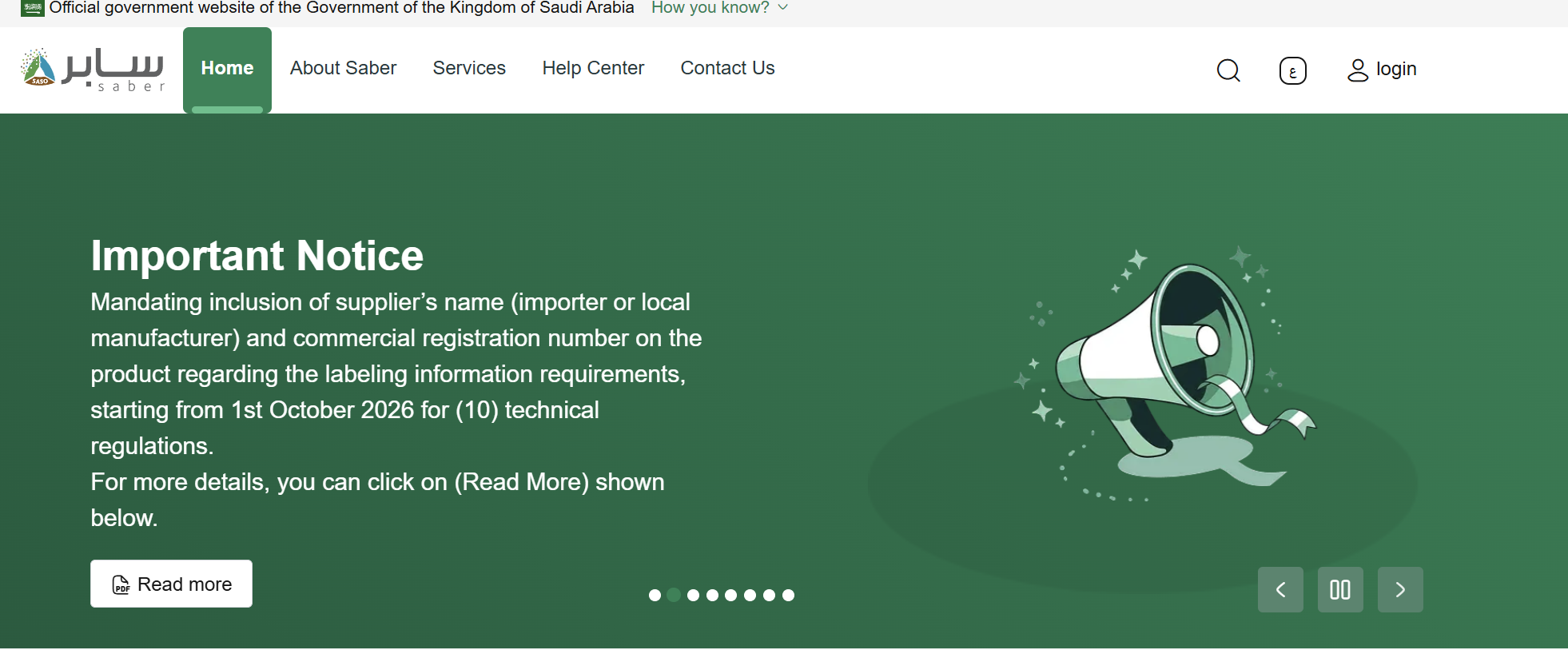
You can check the notice clicking here
It’s worth noting that this isn’t an entirely new obligation. The circular points out that the technical regulations’ labeling provisions already require the supplier’s name and CR number on the product. What has changed is the firm enforcement date and SASO’s stated intention to act against non-compliance.
Which products are affected?
Ten technical regulations are covered, ranging from consumer goods like strollers, child car seats and hoverboards to industrial products like pressure vessels, trailers and building lifts. If your product is certified under any of the regulations below, the new marking applies.
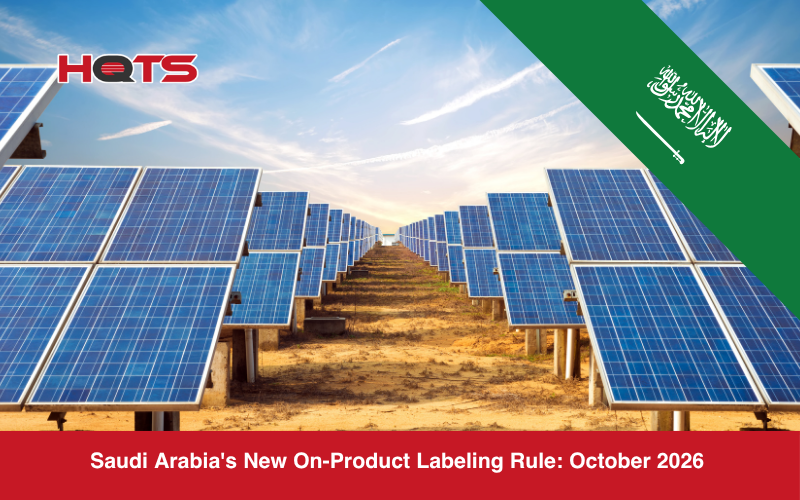
The official list in the circular covers LPG tankers, watercraft, tanks, trailers and semi-trailers, electrical self-balancing boards, simple pressure vessels, child restraint systems and strollers, hydraulic links for building materials, solar photovoltaic systems, and electrical lifts for buildings.
| # | Technical Regulation | Example products |
| 1 | Tanks – Part 2: LPG Tankers | LPG transport tankers |
| 2 | Watercrafts | Boats, jet skis, small vessels |
| 3 | Tanks | Storage and transport tanks |
| 4 | Trailers and Semi-Trailers | Cargo trailers, semi-trailers |
| 5 | Electrical Self-Balancing Boards | Hoverboards, self-balancing scooters |
| 6 | Simple Pressure Vessels | Air receivers, compressor tanks |
| 7 | Child Restraint Systems and Strollers | Car seats, booster seats, strollers, prams |
| 8 | Building Materials – Part 3: Hydraulic Links | Hydraulic binders and related products |
| 9 | Solar Photovoltaic Systems | Solar panels, small PV kits |
| 10 | Electrical Lifts for Buildings and Facilities | Passenger and goods elevators |
What exactly has to appear on the product?
Two pieces of information: the Saudi supplier’s name and that supplier’s commercial registration number. The supplier is the Saudi importer or local manufacturer, not the overseas factory, so exporters must get these details from their Saudi customer.
This is the point most likely to catch exporters out. A Chinese factory shipping strollers to Riyadh cannot use its own company name to meet this requirement. It needs its Saudi importer’s exact registered legal name and CR number, and those details must match what is recorded in SABER.
For manufacturers supplying several Saudi importers, that may mean different product markings for each customer. Build this into production planning early, because changes to molds, rating plates, or printed labels can take weeks.
| Required information | Who provides it | Where it must match |
| Supplier name (importer or local manufacturer) | Saudi importer | SABER product registration and technical file |
| Commercial registration (CR) number | Saudi importer | SABER product registration and technical file |
Does the marking have to be on the product, or is packaging enough?
The official circular says the information must be “on the product.” The safest approach is to mark the product itself with a durable label, rating plate, print, or engraving, rather than relying only on packaging or SABER documentation.
The circular doesn’t go into detail about packaging, but the wording is clear that the requirement relates to the product. Since packaging is often thrown away and SABER data isn’t visible to buyers or market inspectors, a mark on the product itself is the only way to be confident of compliance. The best method depends on the product and what its specific technical regulation allows.
How will SASO enforce it?
SASO will verify compliance using the data submitted through SABER, and violators face penalties under Saudi Arabia’s Product Safety Law. In practice, industry observers expect conformity assessment bodies to check for the marking before issuing a Certificate of Conformity, which would block non-compliant shipments.
According to the circular, SASO will check that covered products meet the requirement using the data uploaded to SABER, and will take regulatory action and apply the penalties set out in the Product Safety Law and its Executive Regulations.
SABER is Saudi Arabia’s official platform for product conformity certificates. According to the U.S. International Trade Administration, it is the electronic system used to obtain Certificates of Conformity for products bound for the Saudi market (source). Because the product photos and label artwork in your SABER technical file will be the evidence SASO reviews, they need to match the physical product exactly.
What is the legal basis for the requirement?
The circular is issued under Article 11 of Saudi Arabia’s Product Safety Law and Article 19 of its Executive Regulations. The Product Safety Law came into force in 2024 as part of a wider overhaul of the Kingdom’s product safety framework.
The circular cites Article 11 of the Product Safety Law, issued by Royal Decree No. M/36, and Article 19 of the Executive Regulations approved by SASO’s Board of Directors on 15/11/2024. The law aims to protect consumers by preventing risks from products placed on the Saudi market and setting out how those risks are handled (UN ESCWA Arab Legislations Portal). It applies to all products, including those sold online, with the exception of products regulated by the Saudi Food and Drug Authority.
The new marking requirement fits SASO’s broader direction. SASO states that it aims to improve product safety by limiting the entry of non-conforming products into the market (SASO Product Safety).
| Legal instrument | Role |
| Product Safety Law (Royal Decree No. M/36), Article 11 | Legal basis for the requirement |
| Executive Regulations, Article 19 | Implementing rules; sets out penalties |
| The ten technical regulations | Contain the labeling provisions being enforced |
| SASO circular to SABER beneficiaries | Sets the October 1, 2026 enforcement date |
What should exporters do now?
Confirm whether your products fall under one of the ten regulations, get your Saudi importer’s legal name and CR number, update the product marking, and make sure your SABER technical file matches. Stock already produced without the marking may need relabeling before it can be certified.
| Step | Action | Owner |
| 1 | Check whether your product falls under one of the ten technical regulations | Exporter / compliance team |
| 2 | Request the importer’s exact legal name and CR number | Exporter, with Saudi importer |
| 3 | Update product labels, rating plates or molds | Manufacturer |
| 4 | Upload updated product photos and label artwork to SABER | Importer / certification partner |
| 5 | Review existing stock and relabel if necessary | Manufacturer / importer |
| 6 | Confirm the updated marking with your conformity assessment body | Certification partner |
How HQTS can help
HQTS supports exporters with SASO technical regulation reviews, SABER registration, and Certificate of Conformity issuance for the Saudi market. If you’re unsure whether your products are affected, or need help updating your technical file before October 1, contact us for a risk free quote.