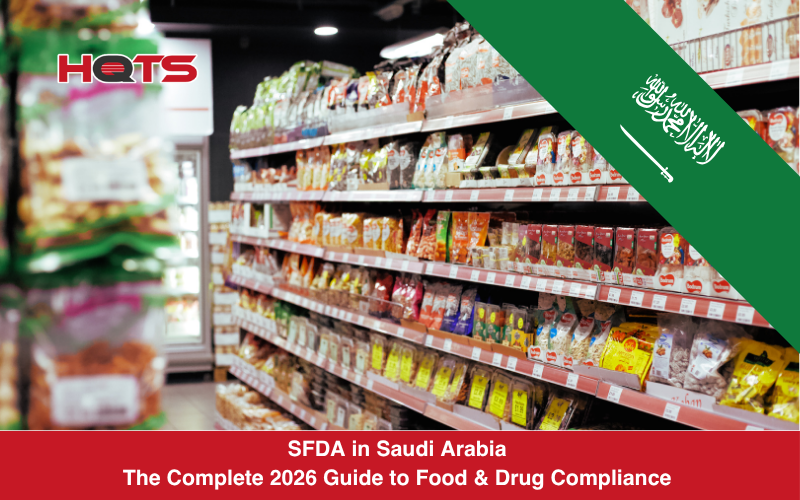
Expanding into Saudi Arabia’s food, pharmaceutical, cosmetics, or medical device market means clearing the Saudi Food and Drug Authority (SFDA) — a regulator that operates separately from, and is often confused with, SASO’s SABER platform. This guide breaks down what the SFDA actually controls, how its registration systems work, what’s changed heading into 2026, and how it fits alongside SABER in the Kingdom’s broader compliance landscape.
What Is the SFDA?
The Saudi Food and Drug Authority (SFDA) is the Kingdom of Saudi Arabia’s independent regulator for food, medicines, medical devices, and cosmetics, reporting directly to the Council of Ministers rather than a single government ministry.
Established in 2003, the SFDA sets the mandatory technical regulations, safety benchmarks, and inspection standards that any regulated product must meet before it can be manufactured, imported, or sold in Saudi Arabia. Unlike a customs authority, the SFDA doesn’t just check paperwork at the border — it maintains ongoing product registration databases, licenses the facilities and individuals handling regulated goods, and runs post-market surveillance once products are already on shelves. The authority is currently executing its fourth strategic plan (2023–2027) and works alongside international bodies like the U.S. FDA and the Codex Alimentarius Commission on regulatory cooperation and food-standard harmonization.
What Does the SFDA Actually Regulate?
SFDA authority covers four main product categories: food and beverages, pharmaceuticals, medical devices, and cosmetics — each with its own registration system and legal basis.
| Category | Governing System | Registration Platform | Typical Validity |
| Food & Beverages | Food regulatory framework | SFDA food registration portal | Ongoing, tied to facility license |
| Cosmetics & Personal Care | Cosmetic Product Notification | eCosma (under GHAD) | 1 year, renewable |
| Medical Devices | Medical Devices and Supplies Regulation (2021) | MDMA certification | Typically 3 years |
| Pharmaceuticals | Drug registration (CTD/eCTD format) | SFDA drug registration system | Varies by product |
Products outside these four categories — electronics, toys, machinery, general consumer goods — fall under a different regulator entirely: the Saudi Standards, Metrology and Quality Organization (SASO), via its SABER platform.
SFDA vs. SABER/SASO: What’s the Difference?
The SFDA and SASO are two separate Saudi regulators covering different product categories — SFDA handles food, drugs, cosmetics, and medical devices, while SASO’s SABER platform handles general consumer and industrial goods.
A common point of confusion for new exporters is treating “Saudi product compliance” as a single system. In reality, it splits by product type:
| SFDA | SASO / SABER | |
| Governs | Food, drugs, cosmetics, medical devices | Electronics, toys, machinery, general goods |
| Digital platform | GHAD, eCosma, food registration systems | SABER |
| Certificate type | Product registration / MDMA / notification | PCoC (product) + SCoC (per shipment) |
| Regulatory basis | Food & Drug Law, Medical Devices Regulation | SALEEM product safety program |
If your product could plausibly be classified under either — supplements, certain baby products, or wellness devices are common gray areas — getting the classification confirmed before you file is worth the delay; refiling under the correct authority after a rejection costs far more time than checking first.
How Does SFDA Product Registration Work?
Registration generally follows five stages: platform account setup, product documentation submission, manufacturer/facility registration, review and approval, and per-shipment clearance.
- Account setup — A Saudi-based importer, distributor, or licensed local representative registers the company on the relevant SFDA platform (GHAD for cosmetics/devices, the food portal for food products). Foreign manufacturers cannot submit directly; a Saudi legal entity must file on their behalf.
- Documentation submission — Composition data, labeling (in Arabic), safety and test certificates, and manufacturer GMP evidence are compiled and submitted through the relevant system — eCosma for cosmetics, the medical device dossier process for MDMA, or the food registration portal.
- Facility registration — For cosmetics and medical devices, the originating manufacturing site must be registered with the SFDA independently of the product itself, usually via a GMP or ISO 22716 certificate rather than a physical inspection.
- Review and approval — The SFDA reviews the file against the applicable technical regulation. Medical devices may also require a Quality Management System audit for higher-risk device classes.
- Shipment clearance — Once a product is registered, each individual shipment still needs a Certificate of Conformity issued through the FASEH system to clear Saudi Customs.
How Long Does SFDA Registration Take?
Most SFDA registrations are completed within 2–6 weeks, though timelines vary significantly by product risk category and whether the manufacturer already holds recognized international certifications.
Cosmetics notifications through eCosma tend to move fastest since they follow a notification rather than pre-approval model. Medical devices generally take longer, especially Class C and D devices that may trigger a manufacturer QMS audit. Manufacturers who already hold CE Marking, FDA clearance, or approval in another Global Harmonization Task Force (GHTF) market typically see shorter review cycles, since the SFDA’s technical requirements are broadly aligned with those frameworks.
Why SFDA Compliance Is Getting More Complex — and More Important
Saudi Arabia’s pharmaceutical market alone is forecast to grow from roughly $9–12 billion in 2025–2026 to well over $17 billion by the early 2030s, and the government’s Vision 2030 Health Sector Transformation Program is pushing local manufacturing targets that directly affect how foreign exporters compete for market access.
Market analysts project the Kingdom’s pharmaceutical sector growing at a compound annual rate of roughly 5–8% through the early 2030s, driven by rising chronic disease rates, expanding insurance coverage, and government healthcare investment. At the same time, Vision 2030’s localization push is reshaping the playing field: public procurement bodies are increasingly favoring SFDA-approved local manufacturing partners, and some 2026 tender rules reportedly reject foreign bids where a locally produced, SFDA-approved alternative already exists. For exporters, this makes early and correctly filed SFDA registration less of a formality and more of a genuine competitive requirement — a delayed or rejected filing doesn’t just cost time, it can cost market position entirely.
Common SFDA Compliance Mistakes to Avoid
The most frequent causes of SFDA delays are misclassifying a product’s regulatory category, submitting incomplete Arabic labeling, and assuming a foreign GMP certificate alone satisfies facility registration requirements.
- Wrong category filing — Submitting a wellness or supplement product as a food item when it should be classified as a drug (or vice versa) triggers a restart under the correct pathway.
- Incomplete labeling — Arabic-language labeling requirements are strict and specific; English-only labels or incorrect nutritional/ingredient formatting are among the most common rejection reasons.
- Assuming GMP alone is enough — A valid GMP or ISO 22716 certificate from the country of origin is necessary but not always sufficient; the manufacturing site itself still needs to be registered with the SFDA before its products can be notified.
- Underestimating shipment-level requirements — Product registration approval doesn’t clear customs by itself; a Certificate of Conformity is still required per shipment through FASEH.
How HQTS Supports SFDA Compliance
Navigating classification, Arabic labeling requirements, and the handoffs between GHAD, eCosma, and FASEH is where most delays originate — particularly for manufacturers filing from outside Saudi Arabia. HQTS provides end-to-end support across pre-market documentation review, accredited laboratory testing, and coordination with your Saudi-based representative, so your product registration and shipment certificates stay aligned from first filing through ongoing market presence.
Contact HQTS today for a free consultation on your SFDA compliance strategy.