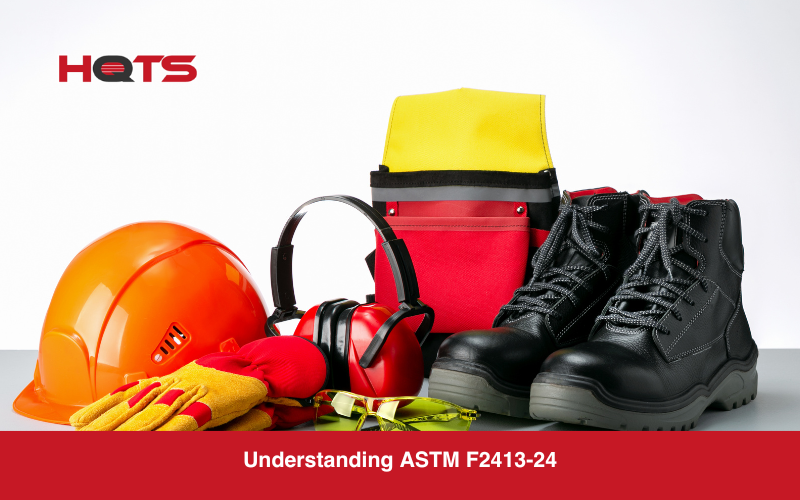
The ASTM F2413-24 is the premier industrial standard establishing design and performance safety criteria for protective toe cap footwear. While not legislation itself, it is strictly enforced in the U.S. through the OSHA Foot Protection Standard (29 CFR 1910.136). Complying with ASTM F2413-24 ensures worker safety and protects businesses from severe regulatory penalties.
Note: If your business operates in Canada, you must comply with the Canadian consensus standard CSA Z195 instead.
What is ASTM F2413-24?
ASTM F2413-24 is the latest standard specification that defines the mandatory performance, testing, and labeling guidelines for protective safety shoes in the workplace. It provides a benchmark for evaluating footwear against hazards like impacts, compressions, punctures, and electrical risks.
Essentially, ASTM F2413-24 outlines the protective requirements that footwear must fulfill to mitigate workplace injuries. While employers are responsible under OSHA guidelines for conducting workplace hazard assessments to determine what specific PPE is required, manufacturers use this standard to test and certify that their shoes provide adequate protection.
The standard dictates testing procedures across several key protective vectors, including impact and compression resistance in the toe area, metatarsal protection, puncture resistance, and electrical insulation properties.
Understanding ASTM Markings
ASTM safety footwear features a standardized, line-by-line classification label located on the tongue or inner lining. Reading this code allows safety managers and workers to quickly match the boot’s certified protections to specific environmental hazards.
ASTM F2413-24 serves as a vital safety communication tool for employers and employees alike. By learning how to decode the ASTM marking block, workers can verify exactly what safety features their boots provide. The marking format typically includes the specific standard year on the first line, followed by gender and core impact/compression resistance, and additional hazard codes on the subsequent lines.
| Code / Marking | Protection Type | Performance Benchmark |
| I/75 | Impact Resistance | Toe protects against falling objects up to 75 ft-lbs of kinetic energy. |
| C/75 | Compression Resistance | Toe protects against crushing loads up to 2,500 lbs. |
| Mt/75 | Metatarsal Protection | Shieling covers the metatarsal upper foot bones against 75 ft-lbs impacts. |
| PR | Puncture Resistance | Bottom of footwear resists sole penetration forces up to 270 lbf. |
| EH | Electrical Hazard Protection | Secondary insulation capable of withstanding 18,000V at 60Hz for 1 minute. |
| SD (10, 35, 100) | Static Dissipative | Reduces static buildup; divided into specific resistance levels (SD10, SD35, SD100). |
| Cd | Conductive Properties | Rapidly grounds static discharge in explosive or highly volatile environments. |
| SR / SRO | Slip Resistance (New Alignment) | Evaluates coefficient of friction (COF); SR indicates traction on wet/dry surfaces, SRO indicates oily-wet traction. |
Changes from the Previous Version (ASTM F2413-18)
The transition from ASTM F2413-18 to ASTM F2413-24 introduces refined definitions, newly integrated unisex sizing guidelines, and formalized alignments with modernized testing methods, notably for advanced slip-resistance (SR/SRO) classifications and updated composite materials.
The previous iteration of this standard, ASTM F2413-18, served as the workplace benchmark for years. However, ASTM International updates these protocols at least every five years to keep pace with structural and technological advancements.
The newest 2024 update addresses modern supply chain shifts by formally standardizing unisex sizing metrics. It also integrates more rigorous test alignments for lightweight composite toe caps and introduces clearer labeling frameworks for slip-resistant outsoles. Tracking these updates from older variations (like ASTM F2413-11 to F2413-18) allows procurement managers to guarantee their inventory matches modern compliance thresholds.
ASTM F2413 Lab Testing and Compliance
To lawfully carry an ASTM marking, protective footwear must undergo strict independent laboratory testing. Obtaining a third-party Certificate of Conformance is the primary method for manufacturers and brands to prove legal compliance and product safety.
While individual employers are not required to test footwear, they must verify that the boots worn by their employees carry official certified test stamps. For footwear manufacturers, suppliers, and global distributors, securing verifiable testing results is an absolute commercial requirement before entering the North American market.
If your business manufactures or sources safety footwear from major manufacturing hubs like China, Vietnam, or India, HQTS offers complete testing solutions. Our state-of-the-art, in-house laboratory facilities specialize in comprehensive ASTM F2413-24 testing protocols. We provide the precise data and authoritative documentation you need to demonstrate compliance, mitigate liability, and protect workers worldwide.
Ready to ensure your protective footwear meets the newest standards? Contact HQTS today to secure your product safety certification.