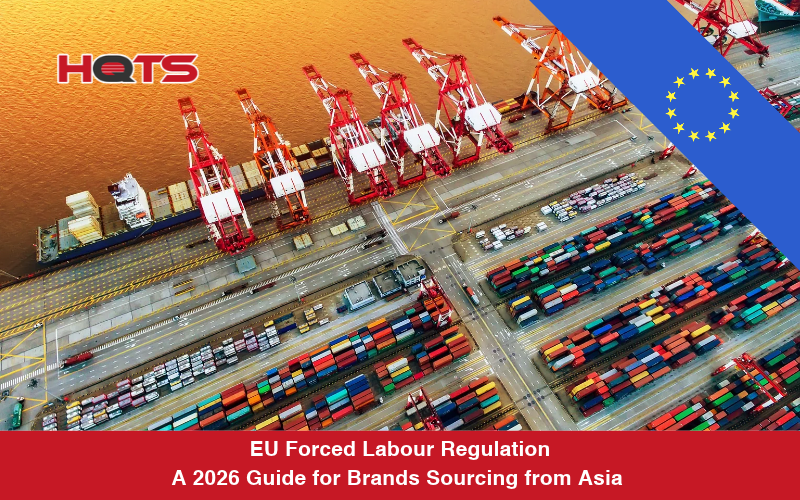
The EU Forced Labour Regulation (Regulation (EU) 2024/3015) bans any product made wholly or partly with forced labour from being sold in, or exported from, the European Union, starting 14 December 2027. It covers every product, every sector and every company size, and the forced labour can have happened anywhere in the world, at any tier of the supply chain. For brands sourcing from China, Vietnam, Bangladesh, India and the rest of Asia, 2026 is the year to get ready: the European Commission published its implementation guidelines in June 2026, and enforcement is now a little over a year away.
This guide explains what the regulation requires, how investigations will work, which Asian sourcing regions and materials carry the most risk, and the practical steps brands can take now to protect their EU sales.
What is the EU Forced Labour Regulation?
The EU Forced Labour Regulation is a product-based market ban: if forced labour was used at any stage of making a product, that product cannot be placed on the EU market, made available there, or exported from the EU. Unlike reporting or due diligence laws, it does not ask companies to file statements. Instead, authorities investigate specific products, and if forced labour is found, the product is banned for everyone who sells it, not only the company that was investigated.
The scope is deliberately wide. According to Baker McKenzie’s review of the Commission guidelines, the ban applies regardless of a product’s origin, sector or type, and forced labour at any stage of extraction, harvesting, production, manufacturing or processing can bring a product into scope. Even when only a small component was made with forced labour, the entire finished product can be affected. “Products” also include agricultural goods, minerals and other raw materials, which matters for brands whose risk sits deep in the supply chain, such as in cotton fields or polysilicon plants.
Timing is another point many brands miss. The ban covers every product placed or made available on the EU market from 14 December 2027, including stock that was manufactured or imported before that date and is still sitting in EU warehouses. Goods ordered from Asian suppliers in 2026 can therefore fall under the rules when they are sold in 2028.
The regulation also sits alongside, not instead of, other EU sustainability laws. It works together with the Corporate Sustainability Due Diligence Directive (CSDDD), the EU Deforestation Regulation (EUDR) and the Batteries Regulation, each of which adds its own supply chain expectations. A comparison with the CSDDD and the US UFLPA follows later in this guide.
When does the EU Forced Labour Regulation apply?
The regulation entered into force on 13 December 2024 and becomes enforceable on 14 December 2027, so brands have roughly 13 months left to prepare. The European Commission describes the current period as an implementation phase that has already started for all actors, with guidelines, a preparedness checklist and sector webinars already available on the Forced Labour Single Portal.
The most important 2026 milestone was the publication of the Commission’s implementation guidelines (C(2026) 4386), adopted on 26 June 2026 and launched with the Single Portal on 30 June. The 70-plus-page document is not legally binding, but it is the clearest signal yet of how authorities will prioritise cases, run investigations and judge a company’s due diligence. Some pieces are still missing: Dentons reported in August 2026 that only eleven Member States had named their competent authorities, and the EU forced labour risk database was still being built at the time several law firms reviewed the guidelines.
| Date | Milestone |
| 14 September 2022 | European Commission proposes the regulation |
| 19 November 2024 | Council adopts the regulation |
| 12 December 2024 | Published in the Official Journal of the EU |
| 13 December 2024 | Regulation enters into force |
| 26–30 June 2026 | Commission adopts implementation guidelines and launches the Forced Labour Single Portal |
| September 2026 onward | Commission webinars, including SME sessions and sector sessions for solar, textiles, electronics, agri-food, automotive and fisheries |
| 14 December 2026 | Deadline for Member States to notify the Commission of their national penalty rules |
| To be confirmed | EU forced labour risk database fully published on the Single Portal |
| 14 December 2027 | Regulation applies; enforcement begins and the Single Information Submission Point for reporting suspected forced labour opens |
Who does the regulation apply to?
It applies to every economic operator that places products on the EU market, makes them available there, or exports them from the EU, with no exemption for company size, sector or country of origin. That includes EU importers, brands and retailers, non-EU manufacturers selling directly into Europe, distributors, and online sellers whose offers target EU consumers.
For an Asia-based supply chain, this means the ban reaches products regardless of who made them. A Vietnamese garment factory, a Chinese electronics assembler and the European brand that sells their goods can all be linked to the same product decision. The Commission guidelines say investigations focus on the specific products and relevant parts of the supply chain, not on a company’s whole business.
Small and medium-sized enterprises are not exempt, but they are treated differently in practice. When deciding which operators to focus on, authorities weigh three factors: how close the operator is to the alleged forced labour and how much leverage it has, the operator’s size and resources, and how complex the supply chain is. SMEs also get dedicated support material on the Single Portal.
| Operator type | Example | In scope? |
| EU brand or importer | A German outdoor brand importing jackets from Vietnam | Yes |
| EU retailer or distributor | A French retailer reselling imported electronics | Yes |
| Non-EU manufacturer selling directly to the EU | A Chinese factory shipping to EU buyers under its own name | Yes |
| Online and cross-border e-commerce sellers | A marketplace seller offering products to EU consumers | Yes |
| EU exporter | An EU company exporting products made with forced labour | Yes |
| Goods in transit or other customs procedures | Goods passing through the EU without release for free circulation or export | Not subject to the border controls |
What counts as forced labour under the regulation?
The regulation uses the International Labour Organization’s definition from Convention No. 29: forced labour is any work or service taken from a person under the threat of a penalty, which that person has not offered voluntarily. In practice, authorities look for three elements together: work or service, no free and informed consent, and some form of coercion. The Commission guidelines confirm the ban covers three types: privately imposed forced labour, state-imposed forced labour, and forced child labour.
The scale of the problem explains why Asian supply chains are in focus. According to the 2021 Global Estimates of Modern Slavery by the ILO, Walk Free and the International Organization for Migration, 27.6 million people were in forced labour on any given day in 2021, including 3.9 million in state-imposed forced labour. Asia and the Pacific hosted 15.1 million of them, more than half of the global total.
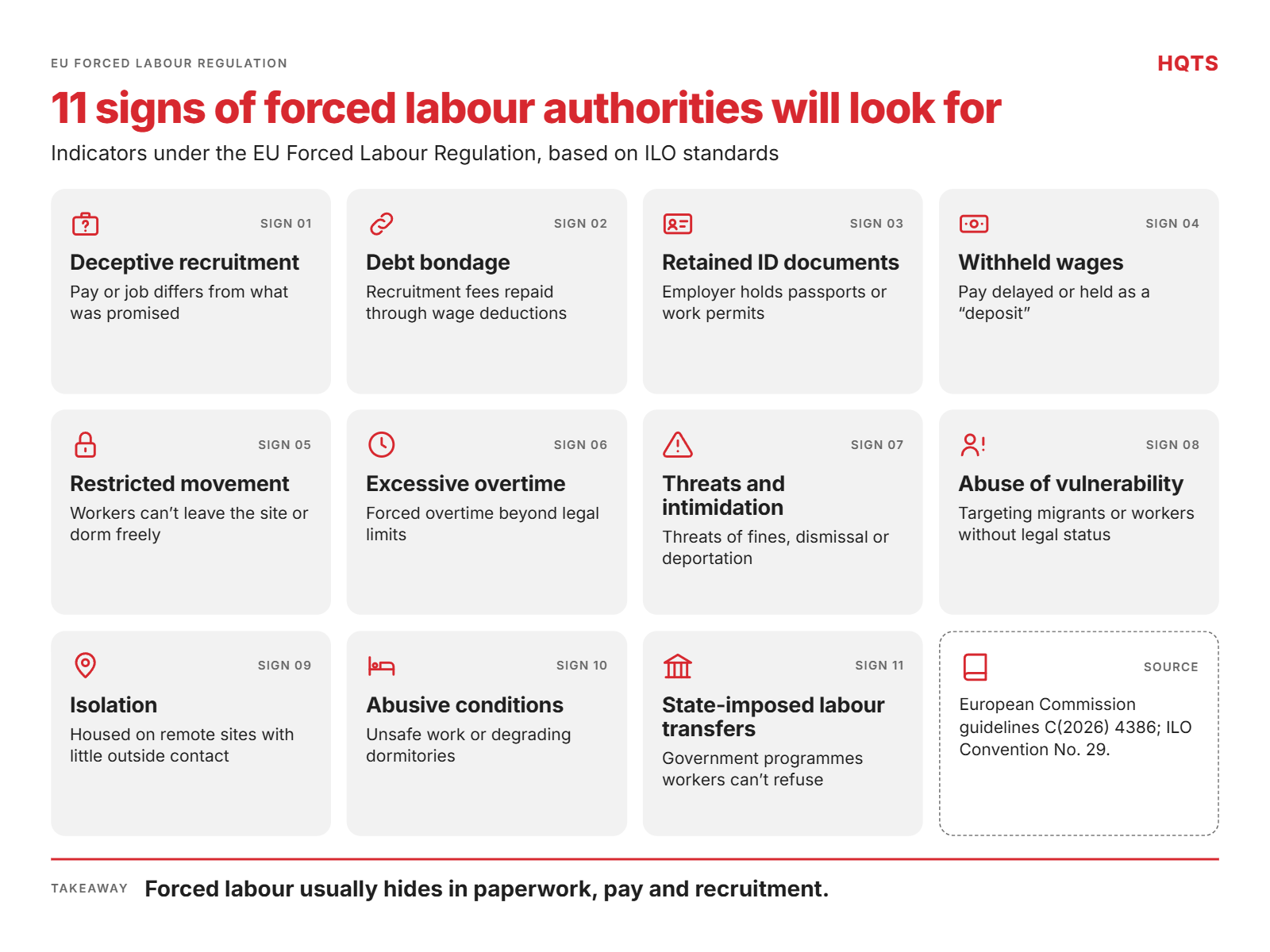
Forced labour is rarely as visible as locked doors. More often it shows up as recruitment debts, held passports, or wages paid late so workers cannot afford to leave. The guidelines list common indicators that investigators and auditors will look for. For suspected state-imposed cases, authorities can also consider surveillance, detention, state-induced coercion and denial of state services.
| Forced labour indicator | What it can look like in an Asian factory or farm |
| Deceptive recruitment | Workers promised different pay, hours or job type than they receive |
| Debt bondage | Migrant workers paying high recruitment fees, then repaying the debt through wage deductions |
| Retention of identity documents | Employer or dormitory manager holding passports, ID cards or work permits |
| Withholding of wages | Wages paid months late, held as “deposits” or paid only at contract end |
| Restriction of movement | Workers unable to leave the factory compound or dormitory freely |
| Excessive overtime | Overtime beyond legal limits, often forced to meet order deadlines |
| Threats and intimidation | Threats of dismissal, deportation, fines or violence for refusing work |
| Abuse of vulnerability | Targeting migrants, minorities or workers with limited language skills or legal status |
| Isolation | Workers housed on remote sites with little contact outside the workplace |
| Abusive working and living conditions | Unsafe workplaces or degrading dormitories workers cannot leave |
| State-imposed labour transfers | Government-organised labour programmes where workers cannot refuse or leave |
How will investigations and enforcement work?
Enforcement is risk-based and runs in three stages: a preliminary assessment, a formal investigation if there is a “substantiated concern”, and a final decision, which should normally come within nine months of the investigation opening. The European Commission leads cases where the suspected forced labour happens outside the EU, which covers most Asian sourcing. National authorities lead cases inside the EU, and customs enforce decisions at the border.
Authorities will not investigate every allegation. Baker McKenzie’s analysis of the guidelines explains that cases are prioritised by the scale and severity of the suspected forced labour, the volume of affected products on the EU market, and the share of the final product made with forced labour. Information can come from complaints, civil society, trade unions, workers, public authorities and the future EU forced labour risk database.
During the preliminary phase, the authority can ask the company for its due diligence records, supply chain information and any evidence that the product is clean. It then has 30 working days from receiving that information to decide whether a substantiated concern exists. Authorities can also skip contacting the company first if doing so could put evidence or workers at risk.
In a formal investigation, companies typically get 30 to 60 working days to answer information requests. The Commission can inspect sites outside the EU only with the consent of both the company and the host country. Cooperation matters: incomplete or late answers can count against the company and contribute to a finding of forced labour.
| Stage | What happens | Key timing |
| 1. Risk-based prioritisation | Authority screens information and selects cases with the highest impact | Ongoing |
| 2. Preliminary phase | Information requests on due diligence, suppliers and evidence | Decision on “substantiated concern” within 30 working days of receiving the company’s information |
| 3. Formal investigation | Detailed information requests, possible inspections, input from workers, unions and NGOs | Companies usually have 30–60 working days to respond |
| 4. Decision | Case closed, or product banned with withdrawal and disposal ordered | Normally within 9 months of opening the investigation |
| 5. Border enforcement | Decision shared through the ICSMS system; customs can stop, seize or refuse affected goods | From the decision onward |
| 6. Review | Company can request a review by showing forced labour has been eliminated | After the decision |
What happens if a product is found to be made with forced labour?
The product is banned from the EU market and from EU export, existing stock must be withdrawn and disposed of at the company’s cost, and companies that ignore the decision face penalties set by each EU Member State. The ban is not limited to the company investigated: it applies to every operator selling the same product, so one supplier’s problem can affect several brands at once.
A ban decision gives companies at least 30 working days to comply for non-perishable goods, or 10 working days for perishable goods. Disposal generally means recycling, donating or destroying the products. Where only a replaceable part of a product was made with forced labour, the disposal order can be limited to that part. Decisions are also published on the Forced Labour Single Portal, which creates a reputational risk on top of the financial one.
Penalties are set at national level and must be effective, proportionate and dissuasive. Member States must notify their penalty rules to the Commission by 14 December 2026. According to Rödl & Partner’s summary of the guidelines, authorities follow a five-step logic, from establishing non-compliance and assessing severity and duration to calculating a base amount. Factors include the value of the products, the operator’s turnover, whether the breach was intentional or negligent, and how well the company cooperated.
A ban is not necessarily permanent. A company can ask for the decision to be reviewed once it shows that forced labour has been removed from its operations or supply chain for the products concerned, for example through remediation or by changing suppliers. The guidelines also name “responsible disengagement” from a supplier as a possible last step where the risk cannot be fixed, such as with state-imposed forced labour.
| Consequence | What it means for your brand |
| Market ban | The product cannot be placed on, sold in or exported from the EU |
| Withdrawal | Products already on the EU market must be pulled from sale |
| Disposal | Stock is recycled, donated or destroyed at your cost |
| Customs action | Shipments can be held, refused release or seized at the border |
| Financial penalties | National fines for non-compliance with a decision |
| Public disclosure | Decisions published on the Forced Labour Single Portal |
| Possible criminal liability | Separate national criminal proceedings can still apply |
Which Asian sourcing regions and sectors carry the highest risk?
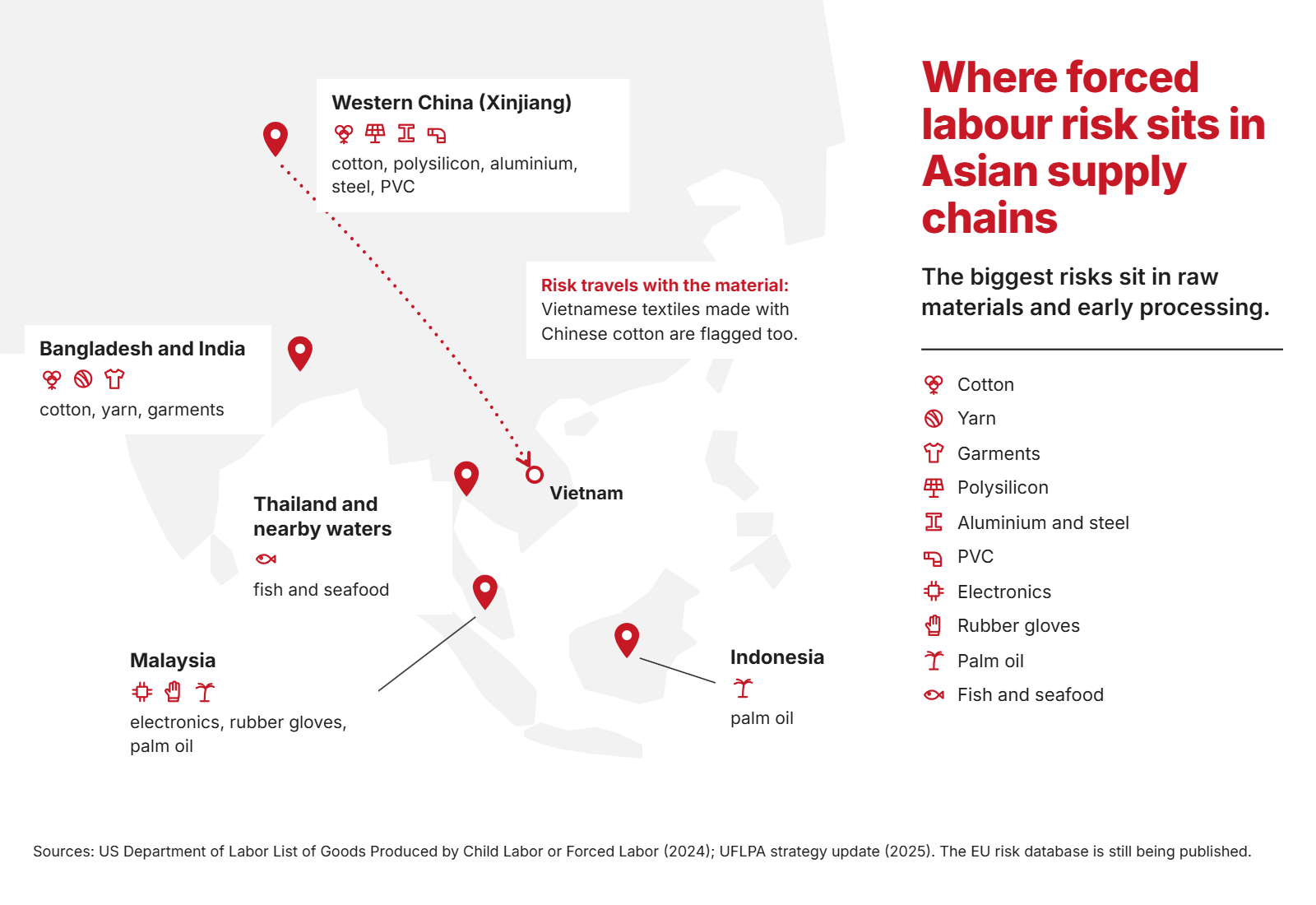
The highest risks for brands sourcing from Asia sit in raw materials and early processing: Xinjiang-linked cotton, polysilicon, aluminium and PVC from China, fish and seafood from Thailand and the wider region, palm oil from Malaysia and Indonesia, and migrant-worker-heavy manufacturing in Malaysia, Bangladesh and India. Finished-goods factories in Vietnam, Cambodia or Bangladesh can be well run and still be exposed through the cotton, yarn or metals they buy.
The EU’s own risk database is not fully published yet, so the best signals today come from established public sources. The US Department of Labor’s List of Goods Produced by Child Labor or Forced Labor covered 204 goods from 82 countries and areas as of its September 2024 update, and Asia, particularly China, has the most goods on the list. The 2024 edition also flagged cotton textile products from Vietnam made with Chinese cotton, a direct warning that risk travels across borders with the material.
State-imposed forced labour is treated as the most serious category. Under the EU regulation, where there is reliable evidence of state-imposed forced labour in specific sectors and regions, those sectors should be identified in the EU risk database. Companies cannot audit their way out of state-imposed forced labour, because independent access to workers is not possible, which is why the guidelines mention responsible disengagement. In the US, the Uyghur Forced Labor Prevention Act (UFLPA) already lists 12 high-priority sectors, after steel, copper, lithium, caustic soda and red dates were added in August 2025. EU enforcement is widely expected to look at many of the same supply chains, but unlike the UFLPA, the EU regulation does not name any country or region, and there is no presumption that goods from a given area are made with forced labour.
| Sector | Main Asian risk locations | Typical forced labour concern | Products affected downstream |
| Cotton, yarn and textiles | China (Xinjiang), India, Bangladesh | State-imposed labour in cotton; debt bondage and excessive overtime in spinning mills | Apparel, home textiles, footwear |
| Apparel and garments | China, Bangladesh, India, Malaysia, Myanmar | Forced overtime, withheld wages, migrant debt | Clothing, uniforms, accessories |
| Polysilicon and solar | China (Xinjiang) | State-imposed labour transfers | Solar panels, electronics |
| Aluminium, steel, copper | China (Xinjiang) | State-imposed labour | Auto parts, consumer goods, packaging |
| PVC and caustic soda | China (Xinjiang) | State-imposed labour | Flooring, cables, plastics, chemicals |
| Electronics and rubber gloves | Malaysia | Recruitment-fee debt, passport retention among migrant workers | Electronics, medical and safety gloves |
| Fish and seafood | Thailand, wider Asia-Pacific fishing fleets | Forced labour at sea, debt bondage | Seafood, fishmeal, pet food |
| Palm oil | Malaysia, Indonesia | Child and forced labour on plantations | Food, cosmetics, cleaning products, biofuels |
| Lithium and battery materials | China | State-imposed labour risks in raw material processing | Batteries, EVs, electronics |
How does the EU regulation compare with the US UFLPA and the CSDDD?
The EU Forced Labour Regulation is a product ban like the US Uyghur Forced Labor Prevention Act (UFLPA), but without its rebuttable presumption: in the EU, authorities must prove forced labour, while under the UFLPA, goods linked to Xinjiang are presumed tainted until the importer proves otherwise. The CSDDD is different again: it is a due diligence law for very large companies, not a product ban, and it will not apply until 2029.
For brands selling into both the US and Europe, the practical overlap is large. The traceability documents, supplier maps and audit records used to clear a UFLPA detention are the same evidence an EU authority will ask for during a preliminary investigation. Building one evidence file per product line saves cost and time across both markets.
The CSDDD was narrowed significantly in 2026. Under the Omnibus I package, Clifford Chance notes that it now covers only EU companies with more than 5,000 employees and over €1.5 billion in global turnover, or non-EU companies with over €1.5 billion of EU turnover, from 26 July 2029. Most mid-sized brands will fall outside the CSDDD but will still be fully covered by the Forced Labour Regulation, which has no size threshold.
| EU Forced Labour Regulation | US UFLPA | EU CSDDD (after Omnibus I) | |
| Type of law | Product market ban | Import ban with rebuttable presumption | Corporate due diligence obligation |
| Applies from | 14 December 2027 | June 2022 (in force) | 26 July 2029 |
| Who is covered | All companies, any size | All importers into the US | EU companies with 5,000+ employees and €1.5bn+ turnover; non-EU companies with €1.5bn+ EU turnover |
| Geographic focus | Worldwide, all products | Xinjiang and listed entities | Worldwide value chains |
| Burden of proof | Authorities must establish forced labour | Importer must prove goods are not linked to Xinjiang or listed entities | Company must show it carried out due diligence |
| Covers exports | Yes, exports from the EU are banned too | No, imports only | Not applicable |
| Main consequence | Ban, withdrawal and disposal of products | Detention, exclusion or seizure at US border | Fines and supervisory measures |
| Due diligence | Voluntary, but key evidence | Needed to rebut the presumption | Mandatory |
How should brands sourcing from Asia prepare?
Brands should map their supply chains down to raw materials, assess forced labour risk by country and material, verify high-risk suppliers with on-site social audits and worker interviews, fix problems through corrective action plans, and keep a documented evidence file for every product line before 14 December 2027. The regulation does not make due diligence mandatory, but the Commission guidelines make clear that documented due diligence is the strongest evidence a company can bring to an investigation.
The guidelines build on the OECD’s six-step due diligence framework: embed forced labour policies into management systems, identify and assess risks, prevent and mitigate them, monitor results, communicate how risks are handled, and provide or support remediation. The steps below translate that framework into practical actions for brands with factories in China, Vietnam and the rest of Asia.
- Set a forced labour policy and assign ownership. Update your supplier code of conduct to reference ILO standards and the EU regulation, and make one team accountable for compliance across sourcing, legal and quality.
- Map your supply chain beyond Tier 1. Identify the factories, subcontractors, fabric mills, spinning mills and raw material sources behind each product, with a focus on cotton, metals, polysilicon, PVC and palm oil derivatives.
- Screen against public risk sources. Check suppliers and materials against the EU risk database once published, the US UFLPA Entity List and the US Department of Labor’s list of goods.
- Audit high-risk suppliers on site. Run social compliance audits with confidential worker interviews, document checks (passports, contracts, payroll) and recruitment-fee reviews, using recognised frameworks such as SMETA, amfori BSCI or SLCP.
- Verify material origin. Use traceability documents, chain-of-custody records and, where relevant, lab-based origin testing such as isotopic testing for cotton.
- Fix issues and remediate. Agree corrective action plans with suppliers, repay recruitment fees where needed, and follow up with verification audits. Disengage responsibly only where risks cannot be fixed.
- Build an evidence file per product. Keep supplier maps, audit reports, certificates and remediation records ready, since authorities can request them with as little as 30 working days to respond.
- Train teams and suppliers. Brief buyers, merchandisers and Asian suppliers on the regulation, its indicators and your expectations.
| Timeframe | Priority actions |
| Now to Q1 2027 | Policy update, supply chain mapping, risk screening of all suppliers and materials |
| Q1–Q2 2027 | Social audits and worker interviews at high-risk suppliers; material traceability checks |
| Q2–Q3 2027 | Corrective action plans, remediation, supplier changes where needed |
| Q3–Q4 2027 | Evidence files per product line; internal mock investigation to test response time |
| From 14 December 2027 | Ongoing monitoring, re-audits and updates as the EU risk database grows |
How HQTS helps brands prepare for the EU Forced Labour Regulation
HQTS gives brands the on-the-ground evidence the regulation looks for, with local teams across China, Vietnam and Southeast Asia and experience supporting more than 50,000 brands. Supplier audits confirm who really makes your products, including subcontractors. Social compliance audits check for forced labour indicators through confidential worker interviews and reviews of passports, contracts and payroll. HQTS also supports SLCP verification, Higg FEM and wider ESG readiness.
Products you order from Asian suppliers today could still be on EU shelves in December 2027. Contact HQTS for a forced labour risk assessment, and build your evidence while there is still time to act.