To succeed in the Nigerian market, understanding the specialized pathways of the Standards Organisation of Nigeria Conformity Assessment Programme (SONCAP) is essential. While Routes A, B, and C cover standard consumer goods, Route X is a high-stakes, specialized category designed for specific high-risk industrial equipment.
What is SONCAP Route X?
SONCAP Route X is the specialized certification pathway mandatory for the importation of LPG (Liquefied Petroleum Gas) and CNG (Compressed Natural Gas) vessels, cylinders, and their related accessories into Nigeria.
Unlike standard consumer electronics or textiles, the equipment under Route X carries significant safety risks. Consequently, the Standards Organisation of Nigeria (SON) enforces a more rigorous verification process to prevent industrial accidents and ensure public safety.
Why Route X Matters: The “Safety First” Protocol
Because Route X deals with pressurized gas equipment, the certification isn’t just a “paperwork” exercise. It ensures that every vessel entering the country can withstand the operational pressures required by Nigerian environmental conditions.
Key Products Under Route X:
-
LPG Storage Tanks and Domestic Cylinders.
-
CNG Conversion Kits and Cylinders.
-
Valves, Regulators, and High-Pressure Fittings.
-
Industrial Gas Piping and Storage Accessories.
The Step-by-Step Certification Process
The process for Route X mirrors the “Unregistered” status (Route A) but with stricter technical oversight.
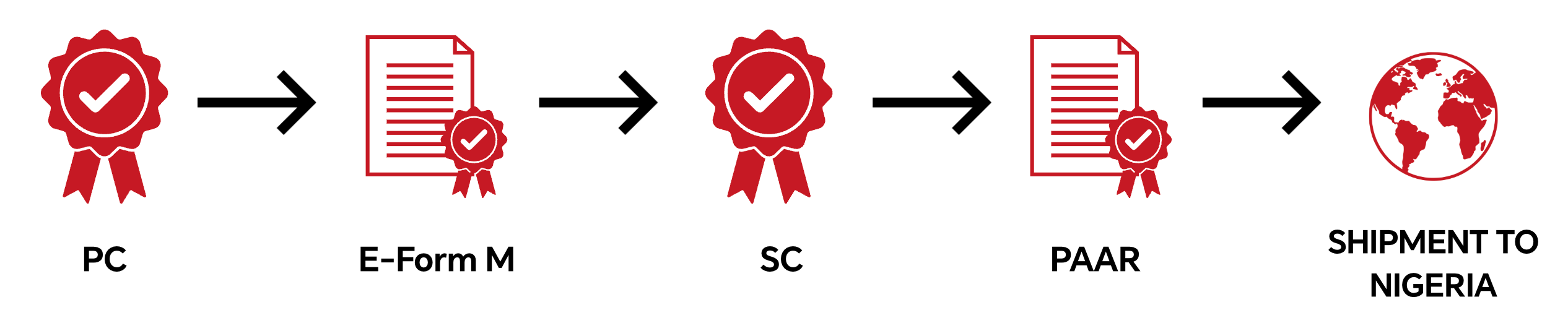
1. Product Certificate (PCX) Issuance
The first step is obtaining the Product Certificate Route X (PCX).
-
Validity: Unlike yearly licenses, this is typically issued for a specific consignment or a limited 6-month window for unregistered manufacturers.
-
Requirements: You must provide comprehensive laboratory test reports from ISO 17025 accredited labs and detailed technical drawings of the vessels.
1.2 Pre-Shipment Inspection (PSI)
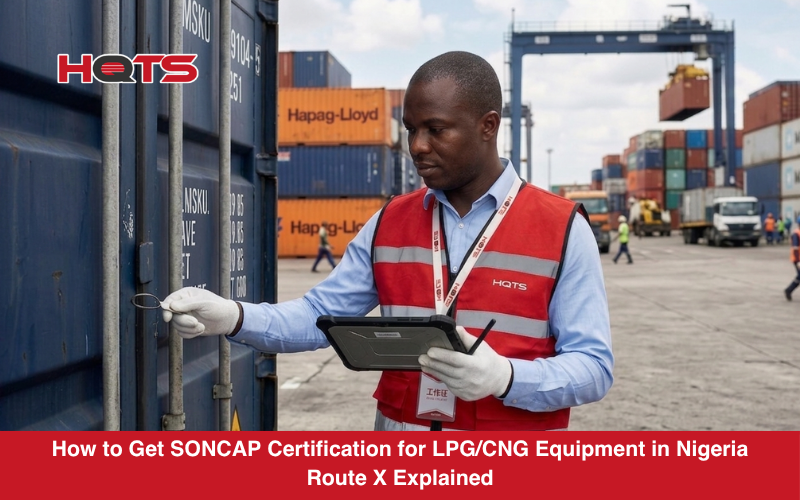
Under Route X, physical inspection is mandatory. An Independent Accredited Firm (IAF)—such as HQTS—will visit the manufacturing site to:
-
Verify the quantity and specifications.
-
Witness pressure tests or safety checks where applicable.
-
Ensure the products match the technical data provided.
2. E-Form M
Before your LPG/CNG equipment leaves the country of origin, you must open an e-Form M, to do this you will need a valid PCX. To complete the E-FORM, submit your PCX to the trade portal. Once validated by SON, it “unlocks” your ability to complete the e-Form M application
4. Issuance of Certificate of Conformity (CoC) and Final SONCAP Certificate (SC)
Once the inspection and documents are verified, the IAF body (like HQTS) issues a Certificate of Conformity (CoC). This document proves the goods meet Nigerian Industrial Standards (NIS). The importer uses the CoC to apply for the final SONCAP Certificate (SC) via the SON portal. This is the “golden ticket” required by the Nigeria Customs Service to clear the goods at the port.
5. PAAR (Pre-Arrival Assessment Report)
The PAAR is the final “green light” from Nigeria Customs. Customs issues the PAAR, which dictates the exact duty and taxes to be paid. Without a Route X-validated SC, the PAAR will be queried or rejected, leading to expensive port delays.
Critical Tips for Importers and Exporters
-
Don’t Skip the E-Form M: You must have a valid PCX before you can open a Form M (the official Nigerian import declaration).
-
Check Your HS Codes: Ensure your Harmonized System (HS) codes specifically match the LPG/CNG category to avoid being incorrectly diverted to a different route.
-
Work with Accredited Labs: SON is very strict about test reports. Ensure your manufacturer uses a lab with verified ISO 17025 credentials specifically for pressure vessel testing.
Frequently Asked Questions (FAQ) about SONCAP Route X
Q: Can I use Route B (Registration) for LPG tanks?
Generally, no. Most high-pressure gas equipment is funneled through Route X to ensure maximum safety oversight, regardless of how often you export.
Q: How long does the Route X process take?
Due to the mandatory physical inspection and technical review, expect the process to take 3 to 5 weeks. It is wise to start the application before the goods are fully manufactured.
Q: What happens if I import without a SONCAP Certificate?
Goods arriving without an SC are subject to detention, heavy fines, and mandatory testing at the importer’s expense. In extreme cases, the goods may be destroyed or deported.
Ensure Your Route X Compliance with HQTS: An IAF Approved Provider
Navigating the complexities of SONCAP Route X for LPG and CNG equipment requires more than just paperwork; it requires a partner with deep technical expertise and official recognition.
HQTS is an Independent Accredited Firm (IAF) officially contracted by the Standards Organisation of Nigeria (SON) to issue Certificates of Conformity (CoC) and facilitate the SONCAP process.
Why Choose HQTS for Route X Certification?
When dealing with high-pressure vessels and gas accessories, the margin for error is zero. HQTS provides a “one-stop” solution to ensure your goods meet Nigerian Industrial Standards (NIS) without the typical logistical headaches.
-
Official IAF Status: As an approved service provider, HQTS has the direct authority to perform the mandatory physical inspections and witness the safety testing required for Route X.
-
Expert Technical Review: Our team specializes in the technical nuances of LPG/CNG equipment, ensuring your laboratory test reports and technical drawings are compliant before they reach the SON portal.
-
Fast-Track e-Form M & PAAR Integration: We ensure your certificates are digitally transmitted to the NICIS II platform, preventing the common “missing document” errors that delay e-Form M approval and PAAR issuance.
-
Global Reach, Local Knowledge: With a presence in over 40 countries, HQTS can conduct the mandatory Route X inspections at the manufacturing site, regardless of where your supplier is located.