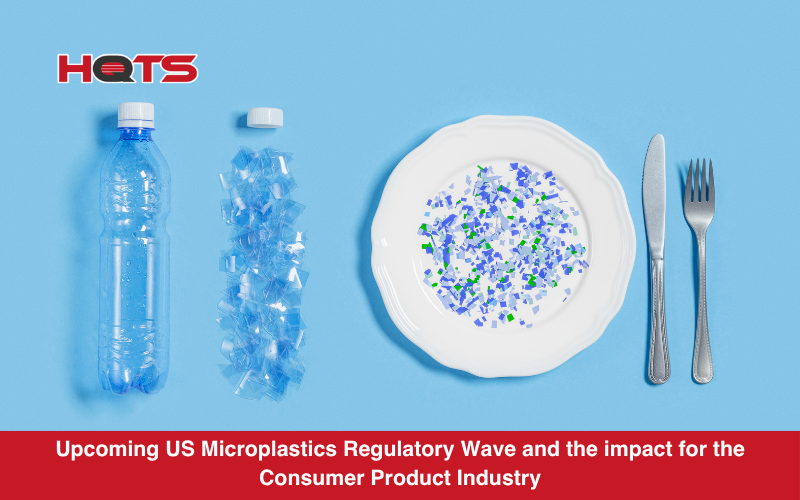
For consumer product companies operating in the U.S., microplastic regulatory compliance has rapidly evolved. Rather than a single sweeping federal mandate, companies must navigate a highly proactive patchwork of state laws alongside expanding regulatory oversight from federal agencies.
The compliance landscape is shifting from targeting intentionally added primary microplastics (like microbeads) to managing secondary microplastics generated by consumer goods, single-use packaging, and synthetic textiles
Understanding the Basics: What Are Microplastics?
Microplastics are solid, synthetic polymer particles that are insoluble in water and measure less than 5 millimeters in size. They are categorized by their origin into primary microplastics—which are intentionally manufactured at a microscopic scale for commercial applications like industrial abrasives or cosmetic film-formers—and secondary microplastics, which result from the physical fragmentation and weathering of larger plastic items over time.
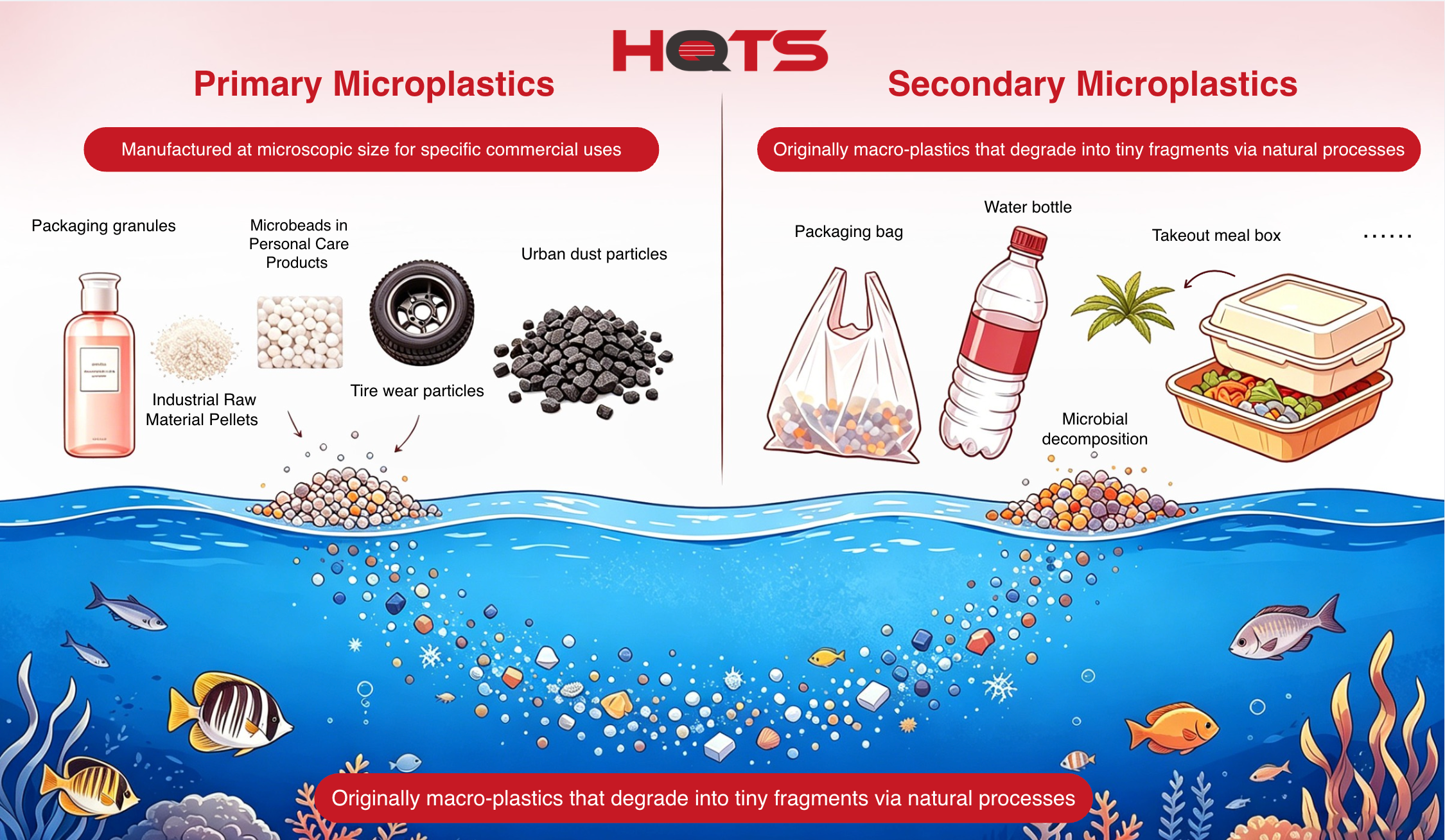
To build a fully bulletproof compliance strategy, quality control teams must distinguish between how these particles enter the supply chain:
- Primary Microplastics: Intentionally added materials. These include pellets (nurdles) used in manufacturing plastic products, industrial blasting abrasives, and the micro-beads historically found in personal care formulations.
- Secondary Microplastics: Unintentional environmental breakdown products. These occur when single-use packaging materials, synthetic commercial fabrics (polyester, nylon), or consumer automotive tires undergo mechanical degradation, friction, or UV exposure, shedding millions of microscopic fibers and fragments into ecosystem pathways.
The Emerging Risk: Microplastics vs. Nanoplastics
The regulatory frontier is expanding to include particles even smaller than standard micro-measurements. Corporate testing frameworks must now account for the transition from the micro-scale to the nano-scale:
|
Particle Classification |
Size Threshold Criteria |
Primary Industrial Sources |
|
Macroplastics |
Greater than 5 mm |
Intact consumer goods, plastic bags, discarded protective packaging |
|
Microplastics |
1 um to 5 mm |
Cosmetic texturizers, textile microfiber shedding, fragmented packaging |
|
Nanoplastics |
1 nm to 1 um |
Advanced chemical coatings, deep cellular breakdown of degraded polymers |
1. State-Level Chemical & Ingredient Prohibitions
What is changing for ingredient compliance?
U.S. states are bypassing gridlocked federal frameworks by integrating microplastics directly into existing toxic substance registries. Instead of traditional “end-of-pipe” waste management, state regulators are treating synthetic polymers as hazardous chemical ingredients. This legally forces multi-state manufacturers to undergo extensive alternative chemical assessments or execute immediate product reformulations to maintain access to key commercial markets.
California’s Safer Consumer Products Program (DTSC)
California’s Department of Toxic Substances Control (DTSC) explicitly added microplastics to its Candidate Chemicals List under the Safer Consumer Products Program.
- The Impact: This framework defines microplastics broadly as solid polymeric materials smaller than 5 mm.
- Compliance Reality: Instead of an immediate blanket ban, this listing legally triggers an Alternatives Analysis. Companies selling consumer products in California that intentionally contain microplastics (or shed them during normal use) must legally prove to the state that no safer, viable alternative exists—or face severe product restrictions and mandatory reformulations.
- Companies selling consumer products in California that intentionally contain microplastics (or shed them during normal use) must prove to the state that no safer, viable alternative exists, or face potential product restrictions and mandatory reformulations.
Microbead-Free Waters Act Expansions
While the federal Microbead-Free Waters Act of 2015 successfully phased out plastic microbeads in “rinse-off” cosmetics like face washes and toothpaste, states are closing remaining loopholes.
- Compliance Reality: New state-level drafts target “leave-on” cosmetics (like glitter, lipsticks, and skin creams) and industrial cleaning abrasives that were originally excluded from the federal ban. Companies must ensure all polymers used for film-forming, texture, or aesthetic effects are fully biodegradable or non-plastic.
2. Extended Producer Responsibility (EPR) & Packaging Laws
How do EPR laws penalize plastic packaging?
Extended Producer Responsibility (EPR) frameworks shifting economic burden from municipal waste management directly to Consumer Packaged Goods (CPG) brands. Under newly deployed state laws, packaging structures that easily fragment into secondary microplastics are assessed high compliance fees. This financial structure penalizes non-recyclable materials while rewarding circular packaging solutions.
|
State Jurisdiction |
Primary Statutory Regulation |
Upcoming Milestones & Compliance Impact |
|
California |
Requires a 25% reduction in single-use plastic packaging by weight and component count by 2032. Establishes ecomodulated fees managed by a Producer Responsibility Organization (PRO). Packaging that easily fragments into microplastics faces severe financial penalties. |
|
|
Colorado |
Mandatory producer funding rules require CPG brands to financially support state recycling infrastructures. Fees are directly tied to material circularity thresholds. |
|
|
Oregon |
Implements strict eco-modulated fee metrics. Packaging designs utilizing low-degradability synthetic polymers incur the highest operational penalty tiers. |
|
|
Maine |
Producers must report exact structural polymer weights. Materials prone to natural mechanical degradation into microparticles face direct market penalties. |
3. Synthetic Textiles & Microfiber Mandates
What are the new compliance metrics for synthetic textiles?
Synthetic textile shedding during commercial and residential laundering is identified as a primary contributor to aquatic microplastic loading. New state regulatory guidelines are mimicking European ecodesign mandates by requiring structural changes in both consumer appliance manufacturing and apparel fabric engineering. Brands are now measured on material shedding velocity rather than just post-consumer waste volume.
- The Impact: Legislation modeled after European standards requires washing machine manufacturers to equip all new residential and commercial machines with mandatory microfiber filtration systems.
- Compliance Reality for Apparel: Fast-fashion and consumer textile brands are facing intense pressure to transition to bio-synthetic blends or utilize anti-shedding yarn finishes. State environmental agencies are building testing baselines to eventually score apparel lines based on their “shedding rate” per wash cycle.
4. Evolving Definitions & Testing Standards
What is the biggest immediate hurdle for corporate compliance teams?
The primary operational challenge for corporate compliance programs is the technical divergence in legal microplastic definitions. While older regulatory baselines solely evaluated particles between 1 mu and 5 mm, current state frameworks have expanded boundaries down to the nanoplastic scale (1 nm to 1 mu), drastically expanding the scope of measurable liability.
The Regulatory Divergence: The California Ocean Protection Council (OPC) finalized its Statewide Plastics Monitoring Strategy and Planning Framework, establishing inter-laboratory standardized sampling methods to measure plastic degradation in state waters. This precise analytical data allows regulators to trace microparticle accumulation back to specific consumer product categories.
Action Items for Compliance Teams
To insulate your brand from legal and financial liability, your compliance department should prioritize the following steps:
- Audit Product Formulations: Review all raw material data sheets (especially in cosmetics, detergents, and coatings) for synthetic polymers that do not meet strict environmental degradation standards.
- Review Packaging Supply Chains: Ensure single-use plastics comply with state EPR registries to avoid massive structural fee penalties.
- Monitor the Global Treaty: Keep a close eye on the UN Intergovernmental Negotiating Committee (INC) on Plastic Pollution. As it works toward a legally binding global plastic treaty, its outcomes will likely form the blueprint for future U.S. federal harmonization.
Navigating the Border: How HQTS Safeguards Your Brand
The complex patchwork of shifting state laws, expanding federal oversight, and changing ingredient definitions means that standard QA checks are no longer enough. The HQTS expert compliance team is uniquely equipped to help U.S. brands proactively understand and navigate these upcoming regulatory changes before they impact your bottom line.
Our specialized teams work directly across your global supply chain to audit raw materials, review product formulations, and verify packaging compliance against the latest EPR frameworks and microplastic thresholds. By identifying synthetic polymers or high-shedding textiles at the source, we help you implement necessary reformulations and structural supply chain adjustments seamlessly.
Ultimately, regulatory compliance isn’t just about factory-level quality—it is your first line of defense at the border. As customs enforcement tightens around microplastic restrictions, unverified goods risk immediate disruption. HQTS provides the rigorous, accredited testing documentation required to ensure your products pass through customs seamlessly, protecting your brand from:
- Costly customs rejections and border delays
- Destroyed inventory at U.S. ports of entry
- Severe financial fines and EPR structural penalties
- Devastating, post-market product recalls
Why Partner with HQTS?
With over 30 years of experience, a global presence in more than 80 countries, and a commitment to rapid, high-accuracy testing, we ensure your products hit the market without imperfections. It’s why over 50,000 brands trust HQTS for their critical quality control needs.
Don’t let regulatory shifts disrupt your supply chain. Contact HQTS today to schedule a microplastic compliance audit for your product line.