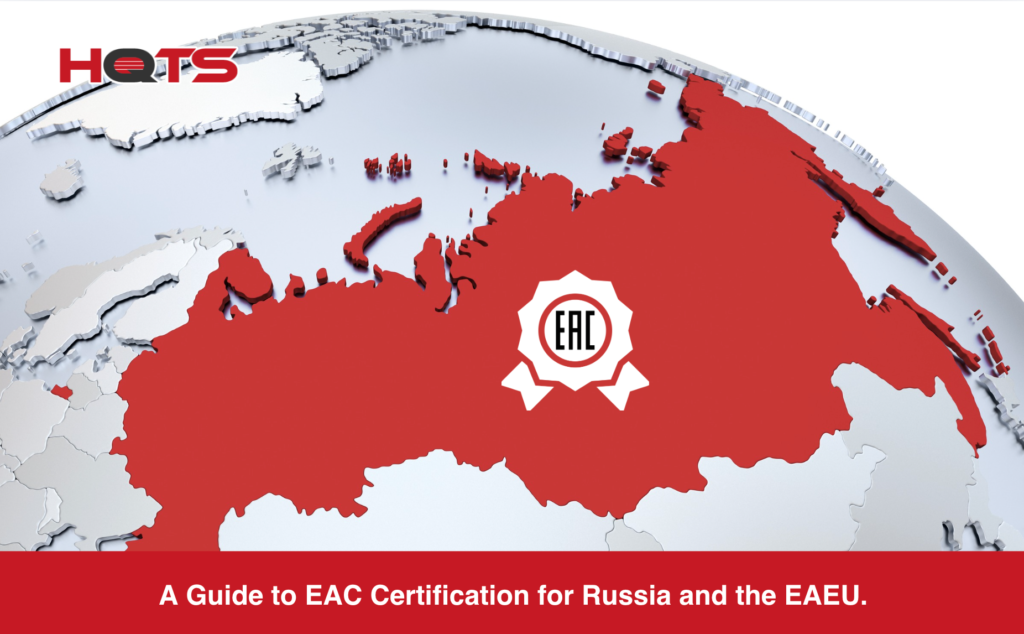
The EAC Mark is a mandatory conformity mark required for all products sold within the Eurasian Economic Union (EAEU). It proves that a product meets all the safety and technical standards required for cross-border trade and customs clearance in the region.
Navigating the EAEU market requires strict adherence to these rules. Failure to comply can lead to seized shipments, heavy fines, or being blacklisted by customs authorities.
What is the EAC Certification Meaning and Full Form?
The EAC full form stands for Eurasian Conformity. The EAC certification refers to the legal process through which an exporter demonstrates that their products comply with the region’s unified Technical Regulations (TR CU and TR EAEU).
Much like the CE mark in Europe, an EAC mark indicates that a product has successfully passed all necessary testing, documentation reviews, and factory audits. It allows goods to circulate freely across the EAEU free trade zone without needing individual national certifications.
Which Countries and Products Require the EAC Mark?
The EAC marking countries consist of five EAEU member states: Russia, Belarus, Kazakhstan, Armenia, and Kyrgyzstan. Any regulated commercial product entering this combined market of nearly 185 million consumers must carry the mark.
Regulated Products Under the EAC Scheme
EAEU regulations cover a massive inventory of consumer and industrial goods split across specific frameworks. Notable categories include:
- Low-Voltage Equipment: Home appliances, cables, and personal electronics (TR CU 004/2011).
- Toys and Children’s Goods: All items intended for infants and children (TR CU 008/2011).
- Industrial Machinery: Pressure vessels, heavy manufacturing tools, and explosion-proof equipment.
- Textiles and Footwear: Clothing, home fabrics, and footwear.
- Food and Medical Equipment: Subject to strict pre-approvals like the SGR State Registration Certificate.
EAC Certification vs. CE Marking: Key Differences
While both certifications serve as passports for regional trade, the EAC mark features far tighter controls regarding legal accountability and local testing than Europe’s CE mark.
To help global exporters understand these differences, the table below highlights how the EAC Certificate deviates from standard European CE protocols:
| Feature | CE Marking (European Union) | EAC Certification (EAEU Markets) |
| Testing Location | Can often use third-party or in-house labs worldwide. | Mandatory testing inside EAEU-accredited laboratories for high-risk goods. |
| Applicant Account | Can be held directly by a foreign manufacturer | Must be held by a legally registered EAEU Authorized Representative (AR) |
| Self-Declaration | Widely used across many low-to-medium risk goods | Permitted only under strict FGIS registry upload via a local representative. |
| Traceability Codes | Serial numbers and batch codes required. | Mandatory integration with Russia’s Chestny Znak digital serialization matrix. |
The 3 Main Compliance Routes & EAC Marking Requirements
Depending on your product’s risk category, you must follow one of three legally binding compliance tracks: an Exemption Letter, a Declaration of Conformity (DoC), or a formal Certificate of Conformity (CoC). Downgrading your compliance route to bypass strict rules is heavily penalized.
- EAC Exemption Letter
This applies exclusively to products outside mandatory regulation catalogues, such as exhibition samples, temporary imports, or non-commercial personal goods. Issued by accredited certification bodies, it is strictly used for customs clearance and cannot be utilized for commercial retail sales.
- EAC Declaration of Conformity (DoC)
Geared toward medium-to-low risk items like household goods and basic building materials. While simpler than a CoC, an overseas manufacturer cannot apply alone; a local EAEU Authorized Representative must file the registration via the official FGIS database. Documents must be backed by valid test reports translated into Russian.
- EAC Certificate of Conformity (CoC)
Mandatory for high-risk goods like toys, medical devices, and industrial machinery. CoCs require sample testing inside EAEU laboratories and a physical or virtual on-site factory audit by accredited experts. Long-term certificates (valid up to 5 years) require recurring annual surveillance audits.
Major 2026 Regulatory Updates: Russian Decree No. 1669
Taking full effect on January 1, 2026, Russian Government Decree No. 1669 has severely tightened regional enforcement. Russian customs now prioritize certifications issued inside Russia and hold the right to reject suspect clearances originated by other EAEU member states.
Exporters must adapt to these shifting protocols to prevent supply chain stoppages:
- Strict Sample Tracking: Custom-made or unauthorized test samples are banned. Samples must come from standard production lines and require special single-batch import permits.
- EAEU Laboratory Mandate: Test reports generated outside the EAEU (e.g., China, EU) are no longer accepted for CoC applications. All physical testing must take place in an FSA-accredited facility.
- Active Registration Checks: Customs authorities check the federal FGIS database in real-time. If a certificate status shows anything other than “Active,” shipments are instantly halted. For macro-level context on trade regulations impacting regional flows, exporters can monitor regional data via World Bank Data.
Documentation, Traceability, and Chestny Znak Rules
Meeting basic EAC certification requirements goes beyond a paper certificate. Exporters must ensure perfect translation alignment, maintain legal authorization, and adopt digital serialization tags on all physical packaging.
Technical Dossiers & Notarization
All labeling, manuals, and technical profiles must be accurately written in the Russian language. For companies originating outside the Hague Apostille Convention—note that mainland China joined the Convention in November 2023, so the double-authentication requirement for Chinese companies should be verified against current Russian consular guidance—the local Power of Attorney (POA) issued to your Authorized Representative must undergo double authentication (domestic notarization plus Russian consular legalization).
Chestny Znak & EAC Marking Requirements
- The EAC Logo: Must be indelibly printed or affixed to the product or its primary packaging, with a minimum height of 5 mm.
- Chestny Znak (Honest Mark): A mandatory Data Matrix barcode that must be printed directly next to the EAC mark for consumer goods like clothing, footwear, cosmetics, and food. This system logs the product’s batch history from production to point-of-sale.
- 10-Year Archiving: All test protocols, technical dossiers, and certification papers must be securely stored by the AR for at least 10 years following the last manufactured batch.
Why Partner with HQTS for EAC Certification?
With over 30 years of experience, a global presence in more than 80 countries, and deep-rooted access to local regulatory networks, HQTS ensures your cross-border operations hit the Eurasian market flawlessly. It’s why over 50,000 brands trust us for their critical quality control and compliance needs.
Keeping pace with the strict 2026 EAEU framework and Russian Decree No. 1669 demands absolute precision. HQTS provides complete end-to-end compliance management to streamline your supply chain.
Our One-Stop EAEU Compliance Services:
- TN VED Matching: Accurate product classification and customs code alignment.
- Testing & Audits: Coordination of mandatory factory audits and sample testing inside accredited EAEU laboratories.
- Legal Setup: Apostille guidance and secure EAEU Authorized Representative (AR) registration.
- Traceability Integration: Chestny Znak digital serialization structuring and real-time FGIS database tracking support.
- Lifecycle Management: Continuous monitoring of certificate status and mandatory annual surveillance audits.
Don’t let shifting regulatory protocols disrupt your business. Contact HQTS today to secure hassle-free customs clearances and confidently grow your market footprint within Russia and the wider Eurasian Economic Union.