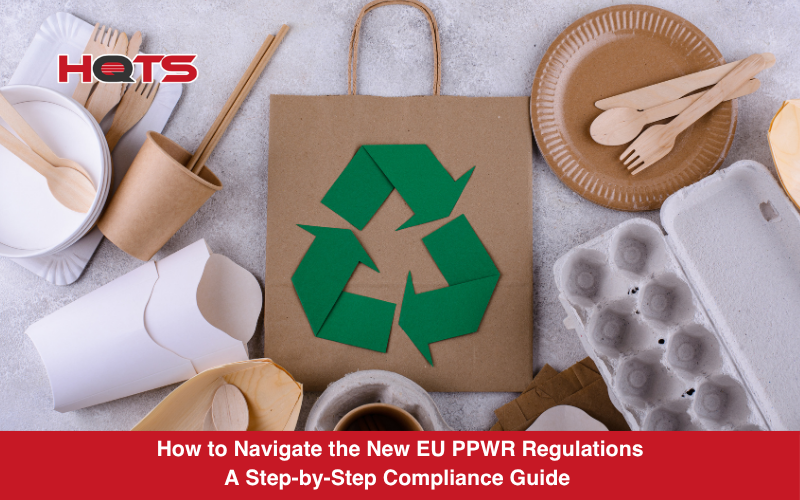
Navigating European regulatory compliance is undergoing one of its most significant shifts in decades. Under Regulation (EU) 2025/40, also known as the Packaging and Packaging Waste Regulation (PPWR), the general application date arrives on August 12. Replacing the old national packaging directives, this binding regulation introduces unified, legally enforceable requirements across all 27 EU member states.
For global manufacturers, exporters, and brand owners shipping packaged goods into Europe, compliance is no longer a downstream consideration—it is a mandatory condition of market access.
Following recent strategic expansions of HQTS’s global testing ecosystem and regional regulatory teams in Europe, HQTS has launched an end-to-end PPWR Navigation & Verification service to help global businesses navigate these stringent requirements without supply chain friction.
What is the Strategy for Navigating the EU PPWR?
Navigating the PPWR requires a proactive strategy focused on material testing for substance limits, securing technical compliance documentation, reviewing packaging dimensions, and aligning with local EPR systems.
Unlike the previous 1994 Directive, which allowed individual EU countries to implement variations in national laws, the PPWR applies directly and uniformly across the entire European Union. Every business placing packaged products on the EU market—regardless of whether they are based in Europe, Asia, or the Americas—must comply.
Navigating this framework successfully demands an immediate operational pivot from reactive compliance to proactive supply chain verification. Companies must systematically review their packaging materials, build robust compliance records, and prepare for upcoming multi-year milestones.
Key Regulatory Requirements Impacting Your Operations
The immediate focus for August 12 revolves around Article 5 chemical restrictions on PFAS and heavy metals, alongside mandatory EU Declarations of Conformity.
Understanding the specific legal hurdles is the first critical step in building your navigation plan. According to global trade policy analysis tracked by organizations like the World Bank, clear compliance frameworks reduce cross-border trade friction and protect international supply chains.
| Compliance Pillar | Key Requirement & Regulatory Scope |
| Chemical Safety (Article 5) | Mandatory concentration caps on PFAS compounds and heavy metals (Lead, Cadmium, Mercury, and Hexavalent Chromium). |
| Technical Files & Declarations | Compulsory technical dossiers and signed EU Declarations of Conformity retained on file for 5 to 10 years. |
| EPR Alignment & Traceability | Verification of active Extended Producer Responsibility (EPR) registrations and compliance across destination EU Member States. |
-
Heavy Metals and PFAS Thresholds
Packaging components must strictly respect legal limits:
- Heavy Metals: The sum of lead, cadmium, mercury, and hexavalent chromium cannot exceed 100 mg/kg.
- PFAS Limits: Food-contact packaging faces strict caps of 25 ppb for individual PFAS, 250 ppb for total targeted PFAS, and 50 ppm for total PFAS content.
-
Mandatory Technical Files & EU Declarations of Conformity (DoC)
Before placing any packaged good on the market, economic operators must draw up an official EU Declaration of Conformity and maintain a complete Technical Construction File. These records must be retained for 5 years (single-use packaging) or 10 years (reusable packaging).
| Requirement Pillar | Specific Threshold / Rule | Required Documentation |
| Heavy Metal Caps | <= 100 mg/kg combined (Pb, Cd, Hg, Cr VI) | Accredited Lab Test Report |
| PFAS Caps | 25 ppb (Individual) / 250 ppb (Targeted) / 50 ppm (Total) | Chemical Analysis Report |
| Conformity File | Valid for all packaging types | Signed EU Declaration of Conformity |
| Record Retention | 5 years (Single-use) / 10 years (Reusable) | Centralized Digital Archive |
Roadmap: How to Navigate PPWR Compliance Step-by-Step
Businesses should follow a structured 5-step roadmap: supplier auditing, chemical testing, technical dossier creation, packaging design optimization, and continuous monitoring.
| Step | Phase | Action Item & Focus Area |
| Step 1 | Supply Chain & Material Audit | Collect full material composition data, Bill of Substances (BOS), and compliance statements from suppliers. |
| Step 2 | Accredited Chemical & Material Testing | Verify heavy metals (Lead, Cadmium, Mercury, Hexavalent Chromium) and PFAS compliance through certified lab screening. |
| Step 3 | Technical Dossier & DoC Issuance | Compile the Technical Construction File and draft/sign the official EU Declaration of Conformity. |
| Step 4 | Packaging Design & Void-Space Review | Audit box dimensions and outer packaging to meet the mandatory 50% maximum void-space ratio. |
| Step 5 | EPR Verification & Continuous Monitoring | Secure and maintain active Extended Producer Responsibility (EPR) registrations across destination EU Member States. |
Step 1: Audit Your Packaging Supply Chain
Engage raw material suppliers and packaging converters to obtain full material composition data. Request Bill of Substances (BOS) details for all primary, secondary, and transport packaging.
Step 2: Perform Laboratory Testing
Send sample materials to an accredited testing laboratory to verify heavy metal levels and screen for PFAS substances. Official lab reports serve as primary evidence during customs checks and market surveillance audits.
Step 3: Compile Technical Construction Files & DoCs
Assemble comprehensive technical files containing engineering drawings, test results, and material descriptions. Authorize and sign the bilingual EU Declaration of Conformity required for EU market clearance.
Step 4: Audit Dimensions for Void-Space Restrictions
Review outer shipping boxes and transport packaging. The PPWR mandates a maximum void-space ratio of 50% for transport and e-commerce packaging, making early design optimization crucial.
Step 5: Verify EPR Registrations
Ensure that your brand or regional importer is fully registered in the official producer registers of each EU Member State where goods are sold, complying with national Extended Producer Responsibility (EPR) requirements.
Phased Timeline: What to Prepare for Next (2028–2040)
The August 12 general application date is the first milestone in a multi-stage transition that introduces digital labels in 2028, mandatory recyclability in 2030, and binding waste reduction targets through 2040.
| Date / Phase | Key Regulatory Focus Area | Core Compliance Mandates |
| August 12, 2026 | General Application Date | General application date; heavy metal & PFAS limits; mandatory Declarations of Conformity (DoC); technical dossiers. |
| August 12, 2028 | Harmonized Labelling & QR Codes | Standardized EU-wide sorting pictograms and digital labeling systems (QR codes for reusable packaging). |
| January 1, 2030 | Design for Recycling & Void Caps | 100% recyclability requirements, 50% max void-space cap in e-commerce, and single-use plastic bans. |
| 2035–2040 | Waste Reduction & Recyclability at Scale | Binding packaging waste reduction targets (10% by 2035, 15% by 2040) and “recyclability at scale” rules. |
- 2028 (Standardized Labelling): Introduction of harmonized EU-wide sorting pictograms and mandatory QR codes for digital product passports and reusable packaging tracking.
- 2030 (Design for Recycling & Single-Use Bans): All packaging must be designed for recyclability. Key single-use plastic formats (such as small condiment packs and pre-packaged fresh produce under 1.5 kg) will be banned.
- 2035–2040 (Recyclability at Scale): Packaging must be recycled at scale using widespread industrial infrastructure, supported by binding packaging waste reduction targets of 10% by 2035 and 15% by 2040 compared to 2018 baselines.
Operational Risks of Misnavigating PPWR
Failing to navigate the PPWR effectively leads to cargo detentions at EU customs borders, severe regulatory fines, mandatory product recalls, and reputational damage.
Regulatory compliance insights published by business institutions like Forbes emphasize that proactive compliance management protects long-term brand equity and prevents costly supply chain disruptions.
- Customs Border Holds: European customs authorities require valid Declarations of Conformity and technical documentation. Missing or non-compliant files lead to immediate cargo holds.
- Forced Recalls & Financial Fines: Market surveillance authorities in EU Member States conduct random spot-checks. Non-compliant products face immediate retail removal and variable administrative fines based on commercial volume.
- Loss of Distribution Rights: Persistent failure to meet EPR registration or substance limits can lead to bans from selling on major EU e-commerce platforms and retail networks.
How HQTS Can Help You Navigate PPWR Compliance
HQTS provides turnkey PPWR compliance solutions, including accredited heavy metal and PFAS testing, technical file construction, packaging design audits, and pre-customs verification.
Navigating complex European environmental regulations requires a knowledgeable partner on the ground. HQTS leverages an extensive global laboratory network and dedicated technical compliance teams to guide manufacturers and exporters through every phase of the PPWR workflow:
- Accredited Laboratory Testing: Fast and reliable screening for lead, cadmium, mercury, hexavalent chromium, and PFAS compounds in accordance with EU testing protocols.
- Technical Dossier & DoC Guidance: Complete support in drafting technical files, risk assessment documentation, and bilingual EU Declarations of Conformity.
- Packaging Design & Void-Space Audits: Pre-shipment evaluations of packaging dimensions, fill ratios, and recyclability criteria to meet upcoming 2030 design standards.
- Supply Chain Compliance Verification: Comprehensive supplier audits to verify material safety data sheets and component compliance before mass production.
Ensure a seamless transition and safeguard your European trade channels. Contact HQTS today to fast-track your EU PPWR navigation strategy.